


Cash Flow Mistakes High Earners Make (And How to Fix Them)
A six-figure income should mean financial freedom. For a striking number of high earners, though, the reality looks entirely different. According to a 2025 Survey, roughly 40% of workers earning between $300,000 and $500,000 say they live paycheck to paycheck, a figure that rivals the financial stress reported by households earning a fraction of that amount. The numbers are jarring, but the pattern behind them is predictable.
Earning more money does not automatically produce financial security. What it does produce is a larger stage for the same underlying mistakes, only now with higher stakes, bigger tax bills, and more complex compensation structures. The cash flow problems that plague high earners are distinct from those facing the average household, and solving them requires a different kind of discipline.
Key Takeaways
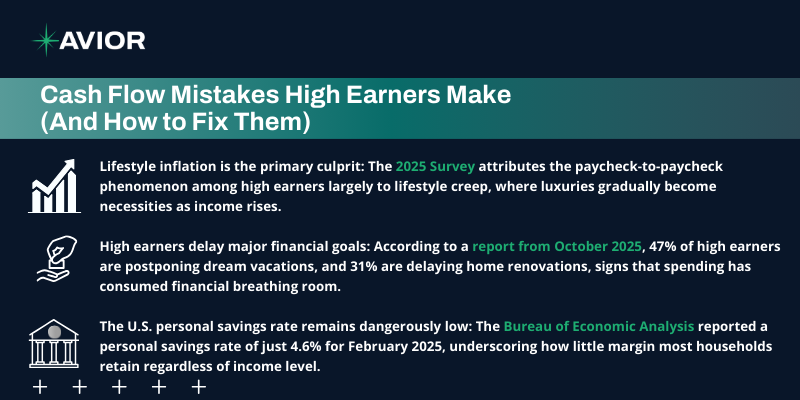
- Lifestyle inflation is the primary culprit: The 2025 Survey attributes the paycheck-to-paycheck phenomenon among high earners largely to lifestyle creep, where luxuries gradually become necessities as income rises.
- High earners delay major financial goals: According to a report from October 2025, 47% of high earners are postponing dream vacations, and 31% are delaying home renovations, signs that spending has consumed financial breathing room.
- The U.S. personal savings rate remains dangerously low: The Bureau of Economic Analysis reported a personal savings rate of just 4.6% for February 2025, underscoring how little margin most households retain regardless of income level.
- Tax withholding gaps create cash flow shocks: Supplemental income, including bonuses, RSUs, and equity payouts, is withheld at a flat 22%, while executives in higher brackets owe 35–37%, creating large unexpected tax liabilities at filing.
- Equity compensation demands proactive planning: Deferred compensation plans can smooth income across years, reduce bracket exposure, and align payouts with lower-tax periods, but only when structured well in advance.
- 401(k) contribution limits increased for 2026: The IRS raised elective deferral limits to $24,500 for 401(k), 403(b), and most 457(b) plans, an opportunity high earners should be maximizing without exception.
Why High Earners Still Struggle With Cash Flow
The Lifestyle Inflation Trap
Lifestyle inflation is quiet. It does not announce itself the way a bad investment does. One year you move into a larger home. The next, the car lease upgrades, the private school tuition gets added, and the club membership renews. Each decision feels reasonable in isolation, and each one permanently raises the floor of what it costs to maintain your life. Over time, spending rises in lockstep with income, and the financial benefit of every raise, bonus, or equity event vanishes before it can compound.
The survey data makes this dynamic concrete. Among workers earning over $500,000, 40% report living paycheck to paycheck, a share nearly identical to those earning $300,000–$500,000. Income keeps climbing while financial pressure does not ease, and that is the defining feature of lifestyle creep. It scales with earnings rather than shrinking from them.
Fixed Costs That Lock You In
When lifestyle inflation takes hold, it converts discretionary spending into fixed obligations. Mortgage payments, private school tuition, lease payments, and club memberships do not flex downward when a bonus misses or a market correction hits. Financial guidelines suggest housing should consume no more than 30% of income, yet most households push toward the ceiling of what their income technically allows rather than staying comfortably below it. The result is a high income paired with almost no financial slack.
This rigidity becomes genuinely dangerous when income is variable, as it is for most high earners. A physician with a partnership draw, a tech executive with RSU-heavy compensation, or an attorney with contingency-fee income can all face months where cash inflows drop sharply while fixed obligations remain constant. Planning for that variability, and building a cash buffer specifically sized to absorb it, is one of the most underutilized strategies at this income level.
The Tax Surprise That Derails Cash Flow
Supplemental Income and the Withholding Gap
Bonuses, RSU vestings, and other forms of equity compensation are classified by the IRS as supplemental wages and withheld at a flat rate of 22%. For an executive whose marginal rate sits at 35% or 37%, the gap between what was withheld and what is actually owed translates into a large lump-sum tax liability every April. Many high earners treat bonus income as spendable cash the moment it hits their account, then face a cash flow crisis months later when the tax bill arrives.
The fix requires treating supplemental income differently from the moment it lands. Setting aside the difference between the 22% withholding rate and your actual marginal rate, ideally into a separate account, eliminates the April shock entirely. Quarterly estimated tax payments, coordinated with a wealth advisor who models your full income picture, keep you from treating withheld amounts as a final settlement rather than a partial one.
Equity Compensation Without a Plan
RSUs, incentive stock options (ISOs), and non-qualified stock options each carry distinct tax treatment, and exercising them without a coordinated strategy can compress substantial income into a single tax year, push you into a higher bracket, and trigger the Alternative Minimum Tax. Many executives hold concentrated equity positions and make exercise or sale decisions reactively, driven by vesting schedules or short-term market moves rather than a longer-term income-smoothing strategy.
A well-structured non-qualified deferred compensation (NQDC) plan addresses this directly by allowing executives to defer salary, bonuses, or equity payouts to future years when income and tax rates may be lower. The strategy requires lead time, since elections are typically irrevocable and must be made before income is earned. This is precisely why proactive planning matters far more than reactive adjustment.
Retirement Contributions as a Cash Flow Strategy
Maximizing Tax-Advantaged Accounts
High earners often treat retirement contributions as an afterthought, something that happens automatically in the background, rather than as an active cash flow management tool. For 2026, the IRS increased elective deferral limits to $24,500 for 401(k), 403(b), and most 457(b) plans. Pre-tax contributions reduce taxable income dollar-for-dollar, which carries meaningful value at higher marginal brackets. An executive in the 37% bracket who maximizes a 401(k) contribution reduces their federal tax bill by over $9,000 on that contribution alone.
Beyond the standard 401(k), high earners with self-employment income or partnership structures should evaluate cash balance pension plans, which can accommodate six-figure annual contributions, often in addition to a 401(k). These plans are particularly powerful for professionals over 40 who want to accelerate tax-deferred savings during peak earning years.
The Danger of Deferring Too Much
Deferred compensation and tax-advantaged accounts offer real benefits, but over-reliance on deferral creates a different problem. Required Minimum Distributions begin at age 73 and force taxable withdrawals regardless of need. For someone who has deferred aggressively throughout their career, RMDs can push retirement income into higher brackets, increase Medicare premiums, and complicate Social Security taxation. A balanced approach, using Roth conversions strategically during lower-income years, maintaining some after-tax liquidity, and modeling future distribution scenarios well in advance, produces better long-term outcomes than pure deferral.
Building a Cash Flow System That Actually Works

Separating Operating Money From Long-Term Capital
One of the most practical structural changes a high earner can make is to stop keeping all liquid assets in a single account. Operating money, the cash covering monthly fixed costs, variable spending, and near-term obligations, should live separately from long-term investment capital and from the dedicated reserves built to absorb tax liabilities or income variability. This separation prevents the psychological tendency to treat available cash as spendable cash, which is the behavioral root of most cash flow problems at this income level.
Automating the allocation helps considerably. When a bonus or equity payout arrives, automated transfers route pre-set percentages to a tax reserve account, an investment account, and a buffer account before any discretionary spending occurs. The system removes the decision from the moment of income arrival, which is precisely when discipline is hardest to maintain.
Reviewing Fixed Costs Annually
Lifestyle inflation is difficult to reverse once it becomes embedded in fixed obligations, which makes prevention significantly more valuable than correction. An annual review of all fixed and recurring expenses, including subscriptions, insurance premiums, lease payments, and membership fees, serves as a check against the gradual accumulation of commitments that erode financial flexibility. The question worth asking at each review is whether the fixed costs taken on over the past 12 months have expanded at a faster rate than the income meant to support them.
Work With Us
High earners face a paradox that standard financial advice rarely addresses. Their cash flow problems stem from the structure of their income rather than from a shortage of it. Lifestyle inflation, supplemental income withholding gaps, uncoordinated equity compensation decisions, and the structural rigidity of elevated fixed costs all compound quietly over time, producing a six-figure income that generates far less financial security than it should. Addressing these issues requires more than general budgeting advice; it requires a coordinated strategy that accounts for how high earners actually earn, spend, and owe.
At Avior, we work with high-income professionals to build cash flow systems that match the complexity of their compensation. From modeling tax liabilities on RSU vestings and bonuses to structuring deferred compensation alongside retirement accounts, our team develops strategies tailored to your specific income picture. If your earnings have grown but your financial breathing room has not, we would welcome the conversation. Schedule a consultation with Avior today.
Investment management and financial planning services are offered through Avior Wealth Management, LLC, an SEC-registered investment adviser. Tax and accounting services are provided by Avior Tax and Accounting, LLC, a wholly-owned subsidiary of Avior Wealth Management, LLC.
Insurance products, including life, disability, long-term care, and annuities, are offered through Avior Insurance. Insurance and annuity products are not offered through Avior Wealth Management, LLC, and are not covered by SIPC. Avior Insurance operates independently to provide insurance solutions tailored to clients’ needs. Insurance products are subject to the terms and conditions of the issuing carrier.
All information contained herein is general in nature and is not to be construed as specific investment advice. Avior does not provide legal advice. Clients should consult their own legal, tax, and financial professionals before making any decisions. All investments involve risk, including the potential loss of principal. Past performance is not indicative of future results.



No Comments
Sorry, the comment form is closed at this time.