


2026 Market Outlook: What Analysts Expect for Stocks, Bonds, and Real Assets
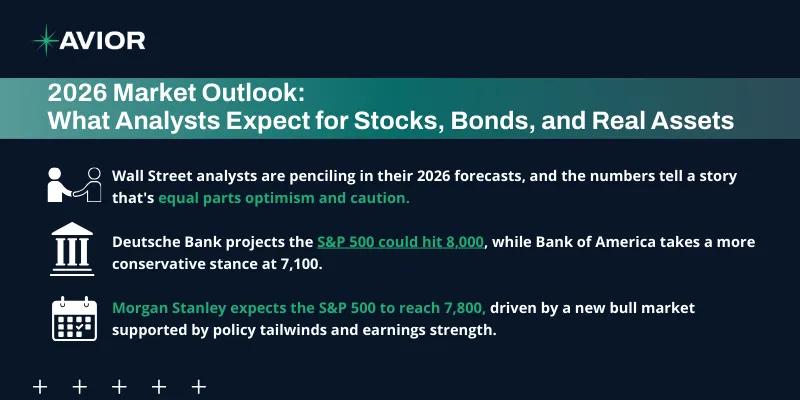
Wall Street analysts are penciling in their 2026 forecasts, and the numbers tell a story that’s equal parts optimism and caution. After three consecutive years of double-digit stock gains, major investment banks see another year of growth ahead, though perhaps at a more measured pace. Bonds might finally deliver the stability investors have been waiting for, while gold continues its record-breaking run on the back of geopolitical uncertainty and central bank buying.
The forecasts rolling out from major firms show remarkable divergence, which tells you something important about the year ahead: nobody really knows. Deutsche Bank projects the S&P 500 could hit 8,000, while Bank of America takes a more conservative stance at 7,100. That spread captures the essential tension facing markets as we move into 2026 – strong fundamentals battling elevated valuations, AI enthusiasm wrestling with bubble fears, and resilient earnings growth facing potential economic headwinds.
Stocks May Keep Climbing
Most analysts lean toward another positive year for equities, though the reasons vary depending on who you ask. The bulls point to continued earnings growth, AI-driven productivity gains, and favorable policy conditions. Morgan Stanley expects the S&P 500 to reach 7,800, driven by a new bull market supported by policy tailwinds and earnings strength.
JPMorgan’s baseline forecast sits at 7,500, with upside potential to 8,000 if the Federal Reserve delivers more rate cuts than currently expected. Their analysis centers on above-trend earnings growth fueled by AI capital spending and shareholder payouts. Tech companies continue pouring money into infrastructure buildouts, which could support broader economic activity even if other sectors slow.
The AI Question Looms Large
Perhaps the biggest unknown for 2026 involves artificial intelligence and whether the massive investment boom represents genuine productivity gains or speculative excess. Companies have sunk hundreds of billions into AI infrastructure, and Wall Street remains divided on whether this spending will translate into earnings growth that justifies current valuations.
Recent Reuters coverage highlights yellow warning signs rather than an outright AI bubble, pointing to “circular” deals where major chipmakers and cloud providers invest in AI firms that then commit to buying large amounts of their hardware or capacity. Power-generation bottlenecks and growing regulatory and compliance burdens on data centers could also slow the buildout. Still, many analysts believe the AI theme has legs, especially if companies can demonstrate concrete revenue and productivity gains from these investments.
Bonds Offer Defensive Appeal
Fixed income markets present a different picture for 2026. After delivering solid returns in 2025, bonds may provide steadier income with less price appreciation. Forecast expects 10-year Treasury yields to remain around 3.75% even as the Fed continues cutting short-term rates, creating a steeper yield curve that benefits intermediate-term holdings.
The challenge for bonds involves supply pressures. Rising government deficits and increased corporate issuance to fund AI investments mean more debt competing for buyers. This dynamic could keep longer-term yields elevated despite Fed easing. Investment-grade corporate bonds currently offer yields only about 0.8 percentage points above comparable Treasuries, based on the ICE BofA US Corporate Index option-adjusted spread, leaving little cushion if economic conditions deteriorate.
Municipal bonds might offer better value for high-income investors, with record issuance creating opportunities in quality credits. Many states built up reserves during recent strong tax revenue years, positioning them well to weather potential slowdowns. Credit quality appears stable across the municipal sector heading into 2026.
Real Assets Show Divergent Paths
Gold continues its remarkable run, with 2026 forecast upward to $4,400 per ounce, representing another 10% gain from current levels. Central bank buying remains strong, particularly from emerging markets diversifying away from dollar reserves. The World Gold Council notes that gold now accounts for a larger share of central bank reserves than U.S. Treasuries for the first time since 1996.
Several scenarios could drive gold higher or lower in 2026. A global downturn with aggressive Fed rate cuts might push prices up as investors seek safe havens. Conversely, a stronger dollar and higher-for-longer interest rates could create headwinds. The baseline expectation suggests modest gains, though demand from jewelry markets shows signs of weakening at current elevated prices.
Commodities face mixed prospects. Base metals like copper and aluminum might see modest gains supported by renewable energy investment, while iron ore prices could decline further given weakness in China’s property sector. Agricultural commodities appear relatively stable with favorable supply conditions offsetting demand concerns.
Risks Cluster Around Policy
The biggest wildcards for 2026 involve policy decisions rather than traditional economic fundamentals. Trade policy, immigration restrictions, and federal spending cuts all carry the potential to reshape growth trajectories in ways that are difficult to predict. Markets have priced in certain policy outcomes, but surprises in either direction could trigger reassessments.
Inflation remains sticky despite recent cooling, creating a dilemma for the Federal Reserve. Labor markets show signs of weakening, but prices for many goods and services haven’t come down as quickly as hoped. This puts the Fed in a difficult position where cutting rates too aggressively might reignite inflation, while holding too steady could allow unemployment to rise uncomfortably.
Geopolitical tensions add another layer of uncertainty. Conflicts in multiple regions could escalate or resolve in ways that affect commodity prices, trade flows, and investor sentiment. The dollar’s strength relative to other currencies will play a role too, particularly for companies with international operations and for emerging market assets.
Work With Us
The 2026 market outlook presents investors with a complex landscape where opportunities and risks exist across asset classes. Stocks might deliver solid returns if earnings growth continues and the AI investment boom proves productive, though elevated valuations leave little room for disappointment. Bonds offer defensive characteristics and steady income, even if price appreciation remains limited by supply pressures. Gold and other real assets could benefit from ongoing uncertainty and central bank diversification, though higher prices may eventually dampen demand.
At Avior, we help clients build portfolios positioned for multiple scenarios rather than betting on single outcomes. Our approach balances growth potential with downside protection, recognizing that forecasts rarely unfold exactly as predicted. Schedule a consultation with our team to review how your current allocation aligns with your goals and risk tolerance, and explore adjustments that might make sense given the opportunities and challenges likely to emerge in 2026.



No Comments
Sorry, the comment form is closed at this time.