


New Year, New Portfolio: 7 Investing Moves to Start the Year Strong
Calendar pages flip to January and resolutions fill notebooks, yet many investors overlook the most practical New Year’s resolution available -: taking control of their investment portfolios through strategic moves designed to improve long-term returns. The start of a new year offers a natural checkpoint for portfolio assessment and adjustment, providing fresh motivation to address issues that might have developed over the previous twelve months while market conditions shifted and account balances changed.
Most people approach January thinking about diet and exercise goals while their investment portfolios remain untouched despite potentially significant drift from target allocations, missed tax-saving opportunities, and contribution limits that reset annually. Strategic portfolio moves made early in the year compound benefits throughout the following months, setting you up for improved performance compared to waiting until year-end when options become limited and deadlines loom. These seven investing actions help position your portfolio for success while taking advantage of opportunities that January specifically provides.
Rebalance Your Asset Allocation
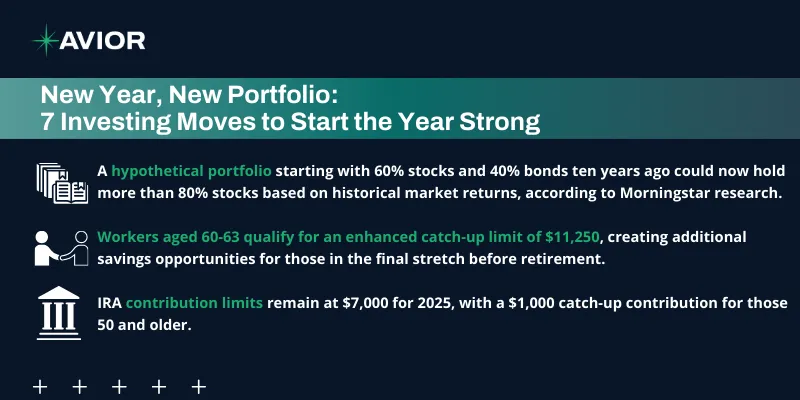
Market movements throughout the previous year likely pushed your portfolio away from its intended asset allocation. Strong stock market performance can leave you with higher equity exposure than planned, while bond market fluctuations affect the fixed income portion of your holdings. A hypothetical portfolio starting with 60% stocks and 40% bonds ten years ago could now hold more than 80% stocks based on historical market returns, according to Morningstar research.
Review your current asset allocation across all investment accounts. Calculate the percentage held in stocks, bonds, international equities, and other asset classes. Compare these figures to your target allocation based on your risk tolerance, time horizon, and financial goals. Someone approaching retirement in the next five years typically carries less stock exposure than someone with three decades until retirement, yet market movements can push both portfolios away from appropriate allocations.
Execute rebalancing primarily within tax-advantaged accounts like IRAs and 401(k)s where you can buy and sell holdings without triggering immediate tax consequences. Required minimum distributions provide an elegant rebalancing opportunity for retirees, taking withdrawals from overweight positions simultaneously meets distribution requirements while bringing your portfolio back toward target allocations. For taxable accounts still accumulating assets, direct new contributions toward underweight positions rather than selling appreciated holdings.
Maximize Retirement Account Contributions
Contribution limits for retirement accounts reset each January, providing fresh capacity to build tax-advantaged savings. The 401(k) contribution limit for 2025 stands at $23,500, with an additional $7,500 catch-up contribution for those aged 50 and older. Workers aged 60-63 qualify for an enhanced catch-up limit of $11,250, creating additional savings opportunities for those in the final stretch before retirement.
Calculate what you contributed to retirement accounts last year and whether you reached maximum allowable limits. Many people contribute enough to capture employer matching, leaving free money on the table otherwise, yet fail to maximize the total contribution potential. For example, someone earning $80,000 who contributes 6% to capture the full employer match saves $4,800 annually, far below the $23,500 limit that could provide additional tax advantages and retirement security.
IRA contribution limits remain at $7,000 for 2025, with a $1,000 catch-up contribution for those 50 and older. These limits apply across traditional and Roth IRAs combined, meaning you cannot contribute the maximum to both account types. Set up automatic monthly contributions early in the year rather than scrambling to fund accounts by the April tax deadline, allowing your investments more time in the market and reducing the burden of large lump-sum contributions.
Harvest Tax Losses Strategically
Tax-loss harvesting extends beyond December’s year-end rush, with January presenting opportunities to capture losses from positions that declined during the previous year’s market volatility. This strategy sells investments showing losses to offset realized capital gains elsewhere in your portfolio, reducing your tax liability while maintaining your overall investment exposure through purchasing similar positions.
Review taxable investment accounts for holdings trading below their purchase price. Even during strong market years, individual positions frequently show losses that create tax-saving opportunities. Investors can use up to $3,000 in net capital losses annually to offset ordinary income, with unused losses carrying forward indefinitely to future tax years.
Avoid wash sale rule violations by waiting at least 31 days before repurchasing the same or substantially identical securities. Selling an S&P 500 index fund and immediately buying another S&P 500 fund from a different company can still trigger the wash sale rule since both track identical indexes. Replace sold positions with similar holdings that maintain your investment strategy, swapping a large-cap growth fund for a different large-cap growth fund with non-overlapping holdings, or replacing individual stocks with sector ETFs providing comparable exposure.
Review and Reduce Investment Fees
Investment fees drain returns systematically year after year, making annual fee reviews essential for portfolio health. A hypothetical 1% annual fee difference on a $500,000 portfolio costs you $5,000 annually, money that could compound for retirement if invested instead of paid to fund managers.
Examine expense ratios on mutual funds and ETFs across all accounts.
Review advisor fees for ongoing services. Fee-only advisors typically charge a certain percentage for assets under management depending on account size and service complexity, while commission-based arrangements create different cost structures. Understand exactly what you pay for investment management, financial planning, and portfolio monitoring. Services providing genuine value through tax planning, estate coordination, and comprehensive financial guidance may justify higher fees, while basic portfolio management alone merits scrutiny.
Increase Emergency Fund Allocations
Investment portfolios function optimally when supported by adequate emergency savings held outside volatile markets. January provides an ideal moment to strengthen your cash reserves, preventing forced liquidation of investments during market downturns to cover unexpected expenses.
Target emergency savings covering three to six months of essential expenses for most households, with self-employed individuals or those in volatile industries potentially requiring larger reserves. Someone with monthly expenses of $5,000 (a hypothetical example) needs $15,000-$30,000 in accessible savings. Calculate your actual monthly fixed expenses, housing, utilities, insurance, food, transportation, and multiply by your target coverage months.
High-yield savings accounts currently offer 4-5% interest rates, providing meaningful returns on emergency funds while maintaining immediate access. Treasury bills offer similar yields with government backing. Money market funds provide another option combining reasonable returns with liquidity. Direct a portion of your monthly surplus toward building emergency reserves until reaching your target level, then shift those contributions toward retirement accounts or other investment goals.
Update Beneficiary Designations
Life changes throughout the previous year may require beneficiary designation updates across retirement accounts, life insurance policies, and other assets passing outside probate. Marriage, divorce, births, deaths, or changed relationships with named beneficiaries all create reasons for review, yet many people last updated designations years or even decades ago.
Pull beneficiary designation forms for all retirement accounts, 401(k)s, IRAs, Roth IRAs, 403(b)s, and pensions. Review primary and contingent beneficiaries listed on each account. Life insurance policies, annuities, and payable-on-death bank accounts also carry beneficiary designations governing asset transfer. Mismatched designations create unintended consequences, an ex-spouse receiving retirement account proceeds despite remarriage, minor children inheriting substantial assets without trust protection, or outdated percentages failing to reflect current family circumstances.
Update designations reflecting your current wishes and family situation. Retirement accounts and life insurance pass directly to named beneficiaries regardless of will provisions, making accurate designations critical for estate planning. Coordinate beneficiary choices with your overall estate plan, considering tax implications for different beneficiary types. Spousal beneficiaries enjoy rollover privileges unavailable to non-spouse beneficiaries, while trust beneficiaries provide control over asset distribution for minor children or beneficiaries requiring structured access.
Establish or Review Your Investment Policy Statement
An investment policy statement documents your investment philosophy, risk tolerance, asset allocation targets, rebalancing guidelines, and decision-making framework. This written plan keeps you anchored during market volatility when emotions tempt reactive decisions that damage long-term returns.
Create a simple statement addressing key investment principles. Define your target asset allocation percentages for stocks, bonds, international holdings, and other asset classes based on your time horizon and risk capacity. Establish rebalancing thresholds, perhaps requiring action when any allocation drifts more than 5 percentage points (a hypothetical threshold commonly used) from targets. Document your approach to market downturns, preventing panic selling during temporary declines.
Review existing investment policy statements for continued relevance as your circumstances evolve. Someone ten years closer to retirement than when they created their initial statement may need more conservative allocations and updated withdrawal plans. Life changes like marriage, children, career shifts, or inheritance receipts warrant statement revisions. Annual January reviews keep your documented strategy aligned with current reality while providing accountability for investment decisions throughout the year.
Work With Us
Starting the year with strategic portfolio moves, rebalancing asset allocations, maximizing contribution limits, harvesting tax losses, reviewing fees, strengthening emergency funds, updating beneficiaries, and documenting investment guidelines, positions your investments for improved long-term performance while addressing issues that accumulated during the previous year. These seven actions take advantage of January’s natural checkpoint for financial assessment and the fresh contribution limits that reset annually.
At Avior, we help clients implement comprehensive portfolio strategies addressing all aspects of investment management from asset allocation and tax efficiency to fee optimization and estate planning coordination. Our approach combines technical expertise with personalized guidance tailored to your specific financial situation and goals. Schedule a consultation with our team to review your current portfolio positioning and develop an action plan for strengthening your investments throughout the year ahead.



No Comments
Sorry, the comment form is closed at this time.