


Capital Gains Strategies for High-Income Investors Before the Year Gets Away From You
For high-income investors, capital gains planning is one of the few year-end exercises that can move the needle on a tax bill by tens or hundreds of thousands of dollars, and the window for action narrows quickly as December approaches. The federal long-term capital gains rates of 0%, 15%, and 20% sound straightforward on paper, but layered on top is the 3.8% Net Investment Income Tax, state-level taxes, and the timing decisions that separate efficient investors from the ones who write checks they did not need to write. The fall and early winter months are when most of the meaningful work happens, because once the year closes, the levers disappear.
The challenge for higher-income households is that the standard advice rarely fits the situation. Rules of thumb built around the average investor break down quickly when concentrated stock positions, large unrealized gains, multiple account types, and meaningful state tax exposure enter the picture. The strategies below focus on what actually moves outcomes for investors with substantial portfolios, and what to consider before the calendar runs out.
Key Takeaways
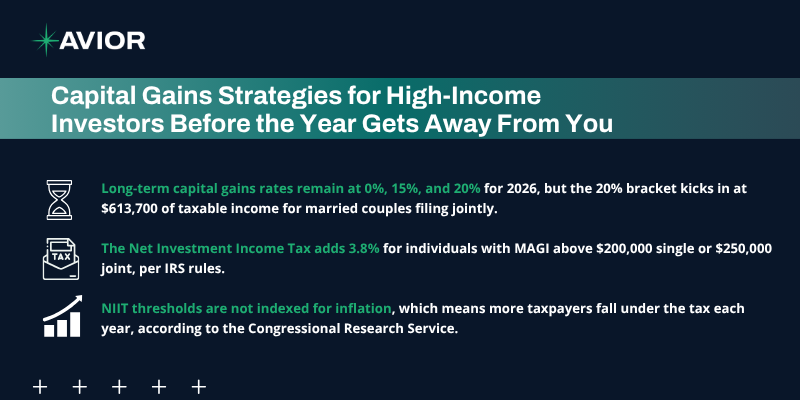
- Long-term capital gains rates remain at 0%, 15%, and 20% for 2026, but the 20% bracket kicks in at $613,700 of taxable income for married couples filing jointly.
- The Net Investment Income Tax adds 3.8% for individuals with MAGI above $200,000 single or $250,000 joint, per IRS rules.
- NIIT thresholds are not indexed for inflation, which means more taxpayers fall under the tax each year, according to the Congressional Research Service.
- Short-term capital gains (assets held one year or less) are taxed as ordinary income, with rates up to 37% federally.
- Tax-loss harvesting allows up to $3,000 of net losses to offset ordinary income annually, with excess carried forward.
- The wash sale rule disallows losses on securities repurchased within 30 days before or after the sale.
- Charitable gifts of appreciated securities allow you to bypass capital gains tax entirely while still deducting fair market value.
Why Year-End Capital Gains Planning Has Real Stakes
The dollar amounts in play for high-income investors make small percentage differences meaningful. A $500,000 long-term gain taxed at the federal 20% rate, plus the 3.8% NIIT, plus a state rate of 5% to 13% depending on where you live, can produce a combined tax bill north of 30%. The same gain harvested across two tax years, paired with offsetting losses, or routed through charitable vehicles can produce a dramatically different result.
Per IRS guidance, holding periods matter enormously. Selling a winning position one day before the one-year mark turns the gain from long-term to short-term, potentially doubling the federal tax rate. For a position with a $250,000 gain, that timing decision alone could swing the tax bill by $40,000 or more. (These figures are illustrative.) The discipline of tracking holding periods is one of the simplest wins available, and one that surprisingly often gets overlooked.
What Strategies Actually Move the Needle?
Several strategies tend to produce meaningful results for high-income households. They work best in combination, and most of them require action before December 31.
Tax-Loss Harvesting at Scale
Selling positions at a loss to offset realized gains is the workhorse of year-end tax planning. Losses first offset gains of the same character (long-term against long-term, short-term against short-term), then the other category, with up to $3,000 of net losses applicable against ordinary income each year and excess losses carried forward indefinitely.
For larger portfolios, the value comes from systematic harvesting throughout the year, not just in December. A diversified portfolio in a volatile year typically contains pockets of underperformance even when the overall account is up, and capturing those losses in real time builds a reserve of carryforward losses that can offset gains for years. The wash sale rule complicates this work, since a loss is disallowed if you buy the same or substantially identical security within 30 days before or after the sale. Replacing a sold position with a similar but not identical holding (a different fund tracking a related index, for example) is one common workaround.
Bunching Gains Into Lower-Income Years
For investors whose income varies year to year, intentionally timing large realizations matters. A consultant who has a low-income year due to a sabbatical, a business owner mid-acquisition, or a retiree who has not yet started Social Security may have substantial space below the 20% bracket threshold of $613,700 for married couples. Recognizing gains during those lower years rather than during peak earning years can save meaningful amounts.
The same logic works in reverse. Deferring gain recognition into a year when a large deduction (charitable contribution, business loss) is expected may push the gain into a lower effective bracket. Multi-year tax modeling tends to surface these opportunities in ways that single-year thinking misses entirely.
Charitable Giving with Appreciated Securities
For investors who plan to give to charity anyway, donating appreciated long-term securities directly to a qualified charity may be one of the most efficient strategies in the tax code. The investor avoids the capital gains tax that would apply to a sale, and may deduct the full fair market value of the donation (subject to AGI limits, generally 30% of AGI for appreciated securities to public charities).
Hypothetical example: an investor with $100,000 of stock originally purchased for $20,000 could sell it, pay roughly $19,040 in federal capital gains and NIIT taxes (assuming the 20% rate plus 3.8% NIIT, plus state taxes), and donate the remainder. Or they could donate the stock directly, deduct the full $100,000 at fair market value, and avoid the capital gains tax entirely. (These figures are illustrative only and do not include state taxes.) Donor-advised funds amplify this strategy by allowing the deduction in a high-income year while the actual grants to charities happen over time.
Qualified Opportunity Zones
For larger gains, Qualified Opportunity Zone investments allow deferral of the capital gains tax if proceeds are reinvested into a qualified fund within 180 days of the sale, with potential exclusion of future gains in the zone investment if held long enough. The rules are detailed and the investments themselves carry meaningful risk, but for substantial gains the deferral and step-up benefits may be significant.
How Should High-Income Households Think About the NIIT?

The 3.8% Net Investment Income Tax applies on top of regular capital gains rates and frequently catches high-income households off guard. Per IRS rules, it applies to the lesser of net investment income or the amount by which MAGI exceeds the threshold ($200,000 single, $250,000 joint).
MAGI Management Strategies
Reducing MAGI in a year with significant capital gains can produce real NIIT savings. Maxing out pre-tax 401(k) contributions, making HSA contributions, and timing deductible expenses into the right year all help. For business owners, retirement plan contributions through SEP-IRAs or solo 401(k)s offer larger deferral capacity than employee plans alone.
The thresholds are not indexed for inflation, per the Congressional Research Service, which means more households cross into NIIT territory each year simply through wage growth. This makes proactive MAGI management an increasingly important annual exercise rather than a one-time concern.
Loss Harvesting to Reduce Net Investment Income
Since NIIT applies to net investment income, harvesting losses to reduce that figure does double duty. The same harvested loss that offsets a regular capital gains tax liability also reduces the NIIT base. For households well above the MAGI threshold, this combined effect can push the effective tax rate on capital gains noticeably higher than it first appears, which makes loss harvesting more valuable than the headline math suggests.
What Should Investors Watch Out For?
A few common pitfalls regularly catch otherwise sophisticated investors.
Mutual Fund Capital Gains Distributions
Mutual funds are required to distribute realized capital gains to shareholders annually, typically in November or December. An investor who buys a fund in October may receive a substantial taxable distribution shortly after, even though their personal holding period was only a few weeks. Reviewing pending distribution dates before making large mutual fund purchases late in the year may avoid an unwelcome tax surprise.
State-Level Tax Exposure
State capital gains rates vary widely. California taxes capital gains as ordinary income at rates up to 13.3%. Other states have no income tax at all. For investors considering relocations, large concentrated position sales, or major liquidity events, the state tax dimension may matter more than the federal piece. Established residency before a major sale (with all the documentation that requires) can be a significant planning consideration.
Estimated Tax Payments
Large realized gains can create estimated tax payment obligations and, if missed, underpayment penalties. The safe harbor rules (paying either 110% of last year’s tax or 90% of the current year’s expected tax for high earners) help, but in years with unusual gains, additional estimated payments may be needed to avoid penalties. The penalties themselves are not enormous, but they are entirely avoidable.
Frequently Asked Questions
When is the deadline for capital gains tax planning each year?
December 31 is the cutoff for most realization decisions. Settlement timing matters for trades made in late December, since the trade date typically governs tax treatment.
Can I sell at a loss and immediately buy the same stock back?
The wash sale rule disallows the loss if you purchase the same or substantially identical security within 30 days before or after the sale. The window is 61 days total, and the rule applies across all your accounts including IRAs.
Do losses in IRAs reduce my taxable capital gains?
No. Gains and losses inside tax-advantaged accounts do not generate current-year tax consequences and cannot offset gains in taxable accounts.
How does the 0% capital gains bracket work for higher-income investors?
The 0% bracket applies only to the portion of long-term gains that falls within the threshold ($98,900 of taxable income for joint filers in 2026). High-income investors rarely qualify directly, though family members in lower brackets sometimes do.
Are there capital gains strategies specifically for concentrated stock positions?
Several. Exchange funds, charitable remainder trusts, structured hedging, and direct indexing for tax-loss harvesting all may help diversify around concentrated positions over time. Each has its own complexity and tradeoffs.
Work With Us
Capital gains planning for high-income investors comes down to a handful of leverage points (loss harvesting, gain timing, charitable giving with appreciated securities, NIIT management, and concentrated position strategy) executed before the year closes. The opportunity is not in any single tactic but in the integration of all of them across a multi-year tax view, paired with careful attention to state-level exposure, estimated payments, and the holding period clock that runs differently for every position. Investors who treat year-end capital gains planning as a strategic exercise rather than a December scramble tend to capture meaningfully better results.
AtAvior, we help high-income clients run capital gains planning as part of an integrated tax and investment strategy, with continuous loss harvesting, multi-year gain modeling, and coordinated execution between our wealth management team and our tax professionals at Avior Tax and Accounting. If you have meaningful unrealized gains, concentrated positions you have been wanting to diversify, or simply want to make sure you are not leaving tax efficiency on the table this year, we would welcome the conversation. Schedule a consultation to get started before the calendar runs out.



No Comments
Sorry, the comment form is closed at this time.