


Planning for Large Expenses Without Disrupting Your Long-Term Investment Strategy
You can fund a large expense without derailing your long-term investments by building a dedicated cash reserve ahead of known costs, sequencing which accounts you tap to limit taxes, and using your portfolio as collateral for liquidity rather than selling appreciated assets that would trigger capital gains and pull money out of the market.
A major purchase rarely announces itself politely. A home becomes available, a business opportunity surfaces, a wedding date gets set, or a renovation runs past its estimate, and suddenly you need a large sum on a short timeline. The instinct for many investors is to reach straight for the brokerage account, since the money sits right there, already grown and seemingly available.
That reflex can quietly undo years of patient investing. Selling appreciated holdings to cover a one-time cost often means a capital gains bill, a smaller balance compounding for the future, and the risk of stepping out of the market right before a strong stretch. With some planning, affluent households can meet sizable expenses while their core portfolio keeps working in the background.
Key Takeaways
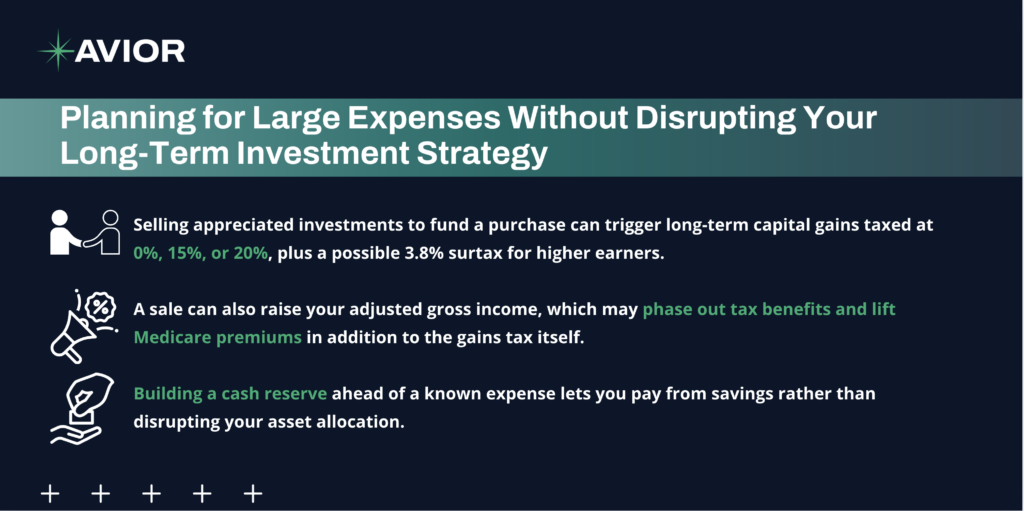
- Selling appreciated investments to fund a purchase can trigger long-term capital gains taxed at 0%, 15%, or 20%, plus a possible 3.8% surtax for higher earners.
- A sale can also raise your adjusted gross income, which may phase out tax benefits and lift Medicare premiums in addition to the gains tax itself.
- Building a cash reserve ahead of a known expense lets you pay from savings rather than disrupting your asset allocation.
- Borrowing against a portfolio through a securities-based line of credit offers liquidity without selling, though it carries interest costs and the risk of a collateral call if markets fall.
- Staying invested matters because missing the market’s best 30 days over a 30-year period cut the average annual return from 8.4% to 2.1%, according research.
- Choosing the right funding source depends on the size of the expense, your timeline, your tax picture, and how much liquidity you want to keep in reserve.
Why Does Selling Investments Cost More Than the Sticker Price?
Liquidating a position to pay for something carries costs that extend well past the amount you withdraw. The most visible is tax. Selling assets held longer than a year produces long-term capital gains taxed at 0%, 15%, or 20% depending on your income, and investors with low-basis holdings can owe a meaningful sum on positions that have grown for years.
A large sale can ripple further. Realizing a big gain raises your adjusted gross income for the year, which may push you past thresholds where tax benefits phase out and where the 3.8% Net Investment Income Tax applies. Higher AGI can also increase Medicare premiums down the road, an effect that surprises many investors who focused only on the headline gains rate.
The quieter cost is opportunity. Money pulled from the market stops compounding, and history rewards staying invested. Research found that missing the best 30 days over a recent 30-year stretch dropped the average annual return from 8.4% to 2.1%, below inflation for the period. Selling at the wrong moment, then sitting in cash, can cost far more than the expense you were trying to fund.
How Can You Build Liquidity Before the Expense Arrives?

The simplest protection is a plan made in advance. When a large cost is foreseeable, a home purchase in two years, a child’s wedding, a planned renovation, you can set aside cash on a schedule so the money is ready without touching investments. Funds earmarked for spending within a few years generally belong in lower-risk vehicles anyway, since you cannot afford a market dip right before you need them.
Where you park that reserve matters. High-yield savings accounts, money market funds, and short-term Treasury holdings keep the money accessible while earning more than idle checking balances. Vanguard groups these liquidity sources into asset accounts you can draw on quickly, which lets you fund a planned expense without selling a single share of your long-term holdings.
The trade-off is that cash held too long carries its own cost. A large balance sitting out of the market for years forgoes growth, so the goal is a reserve sized to known and likely expenses rather than an oversized cash pile. Matching the reserve to your actual spending horizon keeps the rest of your wealth invested where it can compound.
What If the Expense Is Unexpected?
Not every large cost gives you two years of warning. A medical bill, an urgent property repair, or a sudden opportunity can demand cash immediately, and that is where a layered approach helps. A standing emergency reserve, often three to six months of expenses or more for those with variable income, absorbs the first shock without forcing any investment sale.
For costs beyond what cash covers, a pre-established line of credit can bridge the gap. Setting up access before you need it, rather than scrambling during a crisis, gives you room to fund the expense and then repay deliberately. Schwab notes that an account can back up an emergency fund, providing a quick liquidity source for unexpected events without immediately liquidating holdings.
When Does Borrowing Against Your Portfolio Make Sense?
Borrowing against investments lets you raise cash while keeping your holdings intact, which preserves both your market exposure and your cost basis. A securities-based line of credit uses your taxable brokerage assets as collateral, advancing a portion of their value, often somewhere between half and two-thirds, at rates that can sit below what selling would cost you in taxes. The portfolio stays invested, continues earning dividends, and avoids a taxable event.
This approach fits certain situations well. Bridging the gap before a home sale closes, funding a time-sensitive business or real estate opportunity, or covering a short-term need during a market dip you would rather not sell into are common uses. The interest may even be deductible when the proceeds go toward producing taxable income, though that depends on how the funds are used and warrants a conversation with your tax professional.
The risks deserve equal attention. Because the loan is secured by your investments, a sharp market decline can trigger a collateral call, requiring you to add assets or repay quickly, and the lender may sell pledged securities without much notice. Borrowing works best with a clear repayment plan and a portfolio diversified enough to weather volatility, so the strategy supports your goals rather than amplifying risk at the worst moment.
Frequently Asked Questions
Sometimes. Selling can make sense when you hold positions with little or no gain, when you want to reduce a concentrated or overweight holding anyway, or when borrowing costs exceed the tax cost of selling. The point is to compare options rather than defaulting to a sale.
It depends on the cost and timeline, but a common approach earmarks the full expected amount in low-risk accounts as the date approaches. Money you will spend within a few years generally should not stay exposed to market swings, since a downturn could arrive right when you need the funds.
It is a loan that uses your taxable investment portfolio as collateral, giving you access to cash without selling your holdings. You keep market exposure and avoid capital gains, but you pay interest and face the risk of a collateral call if your portfolio’s value drops below a set threshold.
Loan proceeds themselves are not taxable income, which is part of the appeal. Interest may be deductible in certain cases, such as when the funds are used to generate taxable income, though the rules are specific. A tax professional can tell you whether your situation qualifies.
Planning ahead is the strongest defense. A dedicated reserve and a pre-arranged line of credit mean you rarely face the choice of selling under pressure, which is exactly when emotional, poorly timed decisions tend to happen.
Work With Us
Funding a large expense well comes down to preparation and sequencing. Households that build a cash reserve against known costs, keep a layered safety net for surprises, weigh borrowing against selling with a clear eye on taxes, and resist pulling money from the market at the wrong moment tend to cover major purchases with their long-term strategy still intact. Each funding choice carries its own tax and opportunity costs, and weighing them together usually produces a better outcome than reaching for whichever account is closest at hand.
Avior helps clients map out liquidity for life’s bigger expenses so investment goals and spending needs work together rather than against each other. Our advisors can model how a sale, a cash reserve, or a portfolio loan would affect your taxes, your allocation, and your long-term growth, then help you choose the path that fits your circumstances. If you have a major expense on the horizon and want a strategy that protects your portfolio, schedule a consultation with our team.


No Comments
Sorry, the comment form is closed at this time.