


Midyear Portfolio Checkup: What High-Net-Worth Investors Should Review in July
A midyear portfolio checkup is a structured review you run around July to confirm your asset allocation still matches your goals, capture tax-planning opportunities while six months remain to act, and adjust for any income, estate, or market changes since January. For investors with substantial assets, this halfway point offers enough runway to make meaningful moves before the December scramble.
July arrives with most of the year’s financial picture finally visible. Bonuses have landed, business income has taken shape, market returns have moved in one direction or another, and any life changes from the first half are now on the books. That clarity makes the middle of the year a smart time to pause and look at the whole portfolio rather than waiting until tax forms force the issue in spring.
Affluent households carry extra moving parts. Concentrated stock positions, multiple account types, estate considerations, and higher exposure to taxes all reward attention now, when there is still time to coordinate decisions across the rest of the year. A thoughtful July review can surface opportunities that quietly disappear if left until the holidays.
Key Takeaways
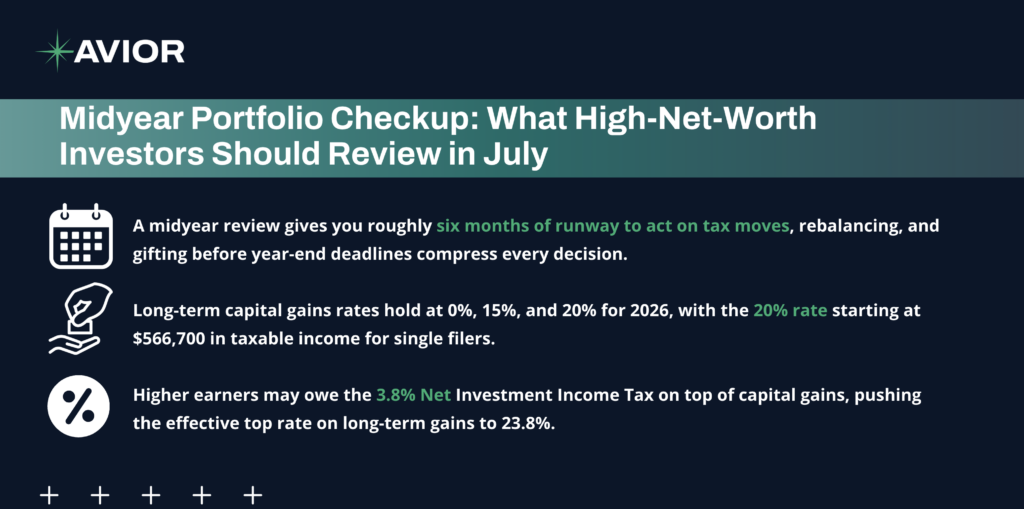
- A midyear review gives you roughly six months of runway to act on tax moves, rebalancing, and gifting before year-end deadlines compress every decision.
- Long-term capital gains rates hold at 0%, 15%, and 20% for 2026, with the 20% rate starting at $566,700 in taxable income for single filers.
- Higher earners may owe the 3.8% Net Investment Income Tax on top of capital gains, pushing the effective top rate on long-term gains to 23.8%.
- The 401(k) employee contribution limit rose to $24,500 for 2026, and checking your pace in July leaves time to adjust deferrals before December.
- The federal estate and gift tax exemption climbed to $15 million per individual in 2026, which may reshape gifting and trust strategies.
- The annual gift tax exclusion stays at $19,000 per recipient for 2026, and starting gifts midyear spreads the work across two quarters.
Has Your Asset Allocation Drifted?
Start with allocation, because market movement quietly reshapes a portfolio even when you do nothing. A strong run in equities can leave you holding far more stock than your target calls for, which raises your risk just as you may be least prepared for a downturn. The reverse happens when bonds outperform and your growth exposure shrinks below plan.
Rebalancing brings the mix back to your intended targets, and July is a reasonable checkpoint to measure the drift. Look at each major asset class against your stated allocation and note where the gap has grown wide enough to matter. Many investors set a threshold, perhaps five percentage points off target, that triggers a trade rather than rebalancing on a rigid calendar.
The tax setting of each account shapes how you rebalance. Adjustments inside tax-advantaged accounts like IRAs and 401(k)s generally create no current tax, since gains in those accounts are not taxable in the year realized. That makes them the natural first place to trim and add when you want to reset allocation without a tax bill, leaving your taxable accounts for moves with a clearer after-tax reason.
What Tax Moves Deserve Attention in July?

Taxes reward early action, and a midyear look gives you room to plan rather than react. Tax-loss harvesting, where you sell positions trading below your cost basis to offset realized gains, works far better when you spot candidates in July and watch them through year-end. Net losses beyond your gains can offset up to $3,000 of ordinary income per year, with the remainder carrying forward.
Capital gains planning belongs on the July list for anyone considering a large sale. Long-term rates stay at 0%, 15%, and 20% for 2026, and the rate you pay depends on where your total taxable income lands. Holding an appreciated asset past the one-year mark shifts it from ordinary income rates, which reach 37%, into the long-term brackets, a gap that can exceed twenty percentage points on the same gain.
Higher-income investors should factor in the 3.8% Net Investment Income Tax, which applies once modified adjusted gross income crosses certain levels and stacks on top of the capital gains rate. For someone in the 20% bracket who also owes this surtax, the effective rate on long-term gains reaches 23.8%, still well under the top rate on wages. Projecting your income now helps you decide whether to accelerate or defer a sale.
Are You On Pace With Retirement Contributions?
A quick July tally of your retirement savings can prevent a year-end shortfall. The 401(k) employee contribution limit increased to $24,500 for 2026, with an additional catch-up for those 50 and older. Dividing the remaining limit across your final paychecks now keeps you from missing the cap or front-loading awkwardly in December.
One change for 2026 affects higher earners directly. Catch-up contributions must now be made as Roth, after-tax dollars if you earned more than $150,000 in the prior year. Confirming how your plan handles this in July gives you time to adjust your deferral elections and avoid a surprise at the next paycheck.
How Do Life and Estate Changes Factor In?
Major life events from the first half of the year ripple through a portfolio, and July is a good time to account for them. A marriage, a new child or grandchild, a business sale, an inheritance, or a move to a different state can each change your tax picture, your risk capacity, or your beneficiary designations. Reviewing these now keeps your plan aligned with your actual circumstances rather than last year’s.
Estate planning deserves a fresh look given recent changes. The federal estate and gift tax exemption rose to $15 million per individual in 2026, which may shift the calculus for families who structured plans around lower thresholds. Some strategies built to remove assets from a taxable estate may warrant revisiting with your advisor and estate attorney.
Annual gifting is another July candidate. The exclusion remains $19,000 per recipient for 2026, and beginning your gifts at midyear spreads the administrative work and lets you coordinate with other tax moves. Families who give to children, grandchildren, or 529 plans often find that starting early reduces the December crunch and the risk of missing the calendar-year window.
Frequently Asked Questions
July sits at the midpoint, after bonuses, business income, and market returns have largely taken shape, yet with roughly six months left to act. That timing lets you make tax and allocation decisions deliberately instead of compressing everything into December when options narrow.
There is no single rule. Many investors rebalance when an asset class drifts a set amount, often around five percentage points, from its target, while others review on a fixed schedule such as semiannually. A midyear check pairs naturally with a year-end one.
It depends on the account. Trades inside IRAs and 401(k)s generally create no current tax, so they are often used first for rebalancing. Selling appreciated positions in a taxable account can realize capital gains, which is why those moves usually call for tax planning.
That hinges on your projected income and goals. Holding an asset past one year qualifies it for lower long-term rates, and your total taxable income for the year determines which bracket applies. A midyear income estimate helps you time a sale to manage the tax cost.
Consider beneficiary designations, annual gifting against the $19,000 exclusion, and whether the higher $15 million exemption changes any trust or transfer strategies. Coordinating these with your advisor and estate attorney while time remains in the year tends to produce cleaner results.
Work With Us
A midyear portfolio checkup turns the middle of the year into a planning advantage. Reviewing allocation drift, harvesting losses, timing capital gains around the 2026 brackets, pacing retirement contributions, and revisiting estate and gifting plans in light of the higher exemption all become easier when six months still remain to act. Each of these decisions connects to the others, and looking at them together in July tends to produce better outcomes than addressing them in isolation come December.
Avior helps high-net-worth families run this kind of coordinated review, weaving investment management, tax planning, and estate considerations into a single strategy rather than separate conversations. Our advisors can model how a sale, a gift, or a rebalancing trade affects your full financial picture and help you act while the timing still works in your favor. If you would like a thorough midyear review tailored to your situation, schedule a consultation with our team.



No Comments
Sorry, the comment form is closed at this time.