
Turning Wealth Into Sustainable Retirement Income: What HNW Families Should Know
Turning wealth into sustainable retirement income means building a plan that pays you a steady, reliable stream for the rest of your life. It works by pulling money from your accounts in the right order, keeping taxes low, and setting a withdrawal pace your savings can support for decades.
Saving for retirement and spending in retirement are two very different skills. For years, the goal was simple. Build the biggest nest egg you could. Then one day the paychecks stop, and a new question takes over. How do you turn that pile of money into income that lasts thirty years or more without running dry?
For wealthy families, the challenge carries extra weight. Larger balances bring bigger tax bills, more account types to juggle, and estate goals layered on top. A smart income plan can help your money go further, lower what you hand to the IRS, and give you the freedom to enjoy what you worked so hard to build. The sections below walk through the most important parts.
Key Takeaways
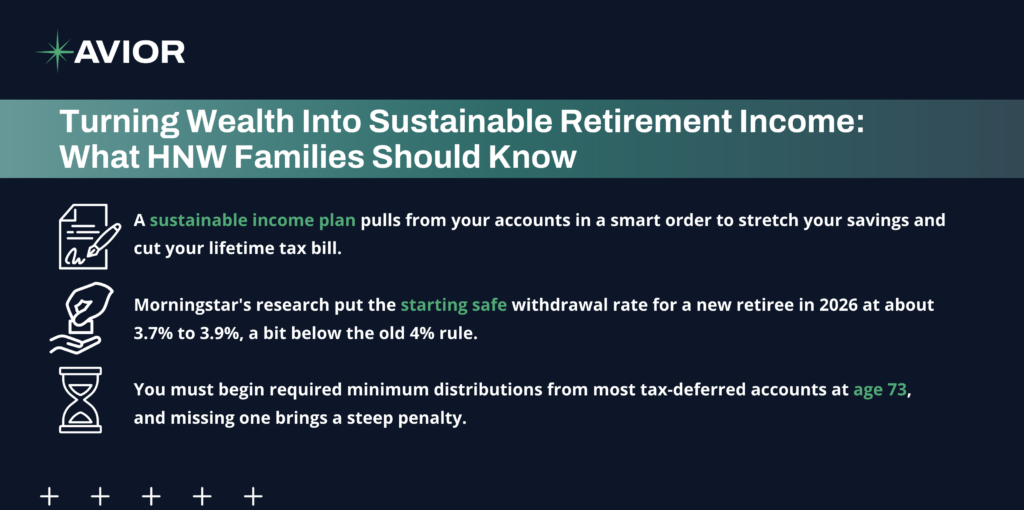
- A sustainable income plan pulls from your accounts in a smart order to stretch your savings and cut your lifetime tax bill.
- Morningstar’s research put the starting safe withdrawal rate for a new retiree in 2026 at about 3.7% to 3.9%, a bit below the old 4% rule.
- You must begin required minimum distributions from most tax-deferred accounts at age 73, and missing one brings a steep penalty.
- Delaying Social Security past your full retirement age, up to age 70, raises your monthly benefit.
- The 2026 Social Security cost-of-living adjustment came in at 2.8%, which lifts benefits to help them keep pace with rising prices.
- Giving directly from an IRA through a qualified charitable distribution lets those 70½ and older donate up to $111,000 in 2026 while trimming taxable income.
What Makes Retirement Income “Sustainable”?
Sustainable income is money that keeps flowing no matter how long you live or how the market behaves. The worry that keeps many retirees up at night is outliving their savings. A good plan takes that fear off the table by matching your spending to what your portfolio can truly support.
Three forces work against your income over time, and a solid plan plans for all of them. Inflation slowly raises the cost of everything you buy, so the same lifestyle costs more each year. Taxes take a bite out of every dollar you withdraw from certain accounts. And market swings can shrink your balance right when you need to pull money out, which does lasting damage. Building a plan that respects these three pressures is what separates income that lasts from income that fades.
How Much Can You Safely Withdraw Each Year?
The safe amount to withdraw is the percentage of your savings you can spend each year with strong confidence the money will last. For decades, the popular answer was the 4% rule. You withdraw 4% of your balance in year one, then adjust that dollar amount for inflation each year after.
Newer research suggests a slightly more careful starting point. Morningstar recently pegged the safe rate for someone retiring in 2026 at roughly 3.7% to 3.9% for a 30-year retirement with a high chance of success. The exact number that fits you may be higher or lower, depending on your age, your health, and how flexible you can be with spending in a down market.
Wealthy families often have room to be smart here. A flexible approach can help.
- Spend a little less in down years. Trimming withdrawals when the market drops helps your portfolio recover and last longer.
- Spend a little more in strong years. When investments do well, you may have room to enjoy extra income without risking your future.
- Lean on other income first. Social Security, a pension, or rental income can cover part of your needs, so you pull less from your portfolio.
This kind of give-and-take, sometimes called a guardrails approach, tends to protect your money far better than withdrawing the same rigid amount every single year.

Which Accounts Should You Tap First?
The order you withdraw from matters as much as how much you withdraw. Most wealthy families hold three buckets of money, and each one is taxed differently. Getting the sequence right can save a large amount in taxes over a full retirement.
Taxable accounts, like a regular brokerage account, usually come first. You have already paid tax on the contributions, and long-term gains are taxed at lower rates. Tax-deferred accounts, like a traditional IRA or 401(k), often come next, since every dollar you pull out counts as ordinary income. Roth accounts generally come last, because they grow tax-free and never force you to take money out during your lifetime.
That said, the classic order is a starting point, not a strict rule. In some years it pays to pull a bit from a traditional IRA early, even before you have to, to fill up a lower tax bracket and shrink future required withdrawals. A thoughtful plan looks at your full picture each year and adjusts, rather than following one formula blindly.
What Should You Know About Required Minimum Distributions?
Required minimum distributions, or RMDs, are the amounts the government forces you to withdraw from most tax-deferred accounts once you reach a certain age. The rule exists because you got a tax break when you put the money in, and the IRS eventually wants its share.
You must start taking RMDs at age 73 for most retirees today. The amount is based on your account balance and your life expectancy, and it grows as a share of your balance as you age. Roth IRAs sit outside this rule, since they never require withdrawals while you are alive, which is one reason they are so valuable late in life.
Skipping an RMD is an expensive mistake. The penalty runs as high as 25% of the amount you failed to take, though it can drop to 10% if you fix it quickly. For families with large tax-deferred balances, RMDs can push you into a higher bracket and raise your Medicare premiums, so planning ahead in your sixties often pays off more than scrambling at 73.
How Do Social Security and Charitable Giving Fit In?
Social Security forms the backbone of many retirement income plans, and when you claim it makes a real difference. You can start as early as 62, but your monthly check grows for every year you wait, up to age 70. For a healthy person who expects a long life, delaying can mean a much larger benefit for the rest of that life.

Two more points are worth keeping in mind:
- Your benefit adjusts for inflation. The 2026 COLA raised benefits by 2.8%, helping your income keep pace with rising costs, something most portfolio withdrawals do not do automatically.
- Coordinating matters. How much you pull from other accounts can affect how much of your Social Security gets taxed, so the pieces work best when planned together.
Charitable giving offers a graceful way to lower taxes while supporting causes you care about. A qualified charitable distribution lets anyone 70½ or older send money straight from an IRA to a charity, up to $111,000 per person in 2026. The gift counts toward your RMD, yet it never shows up as taxable income, which makes it one of the most tax-friendly ways for wealthy retirees to give.
Frequently Asked Questions
How much money do I need to retire comfortably?
There is no single number, since it depends on your spending, your other income, and how long your retirement lasts. A common starting point estimates your yearly expenses, subtracts income like Social Security, then checks whether a safe withdrawal from your savings can cover the rest.
Is the 4% rule still a good guide?
It remains a useful starting point, though recent research suggests a slightly lower rate near 3.7% to 3.9% may be safer for new retirees today. Your ideal rate depends on your age, health, and willingness to adjust spending when markets fall.
When should I claim Social Security?
That depends on your health, your other income, and your family history. Waiting until age 70 gives you the largest monthly benefit for life, while claiming at 62 gives you smaller checks sooner. Many people in good health benefit from waiting.
How can I lower taxes on my retirement income?
Common approaches include withdrawing from accounts in a tax-smart order, converting some money to a Roth in low-income years, giving through qualified charitable distributions, and timing large withdrawals carefully. A coordinated plan usually saves more than any single move.
What happens if I forget to take my RMD?
You may face a penalty of up to 25% of the amount you should have withdrawn. The penalty can drop to 10% if you correct the shortfall within two years, so acting fast helps if a mistake happens.
Work With Us
Building income that lasts is the real work of retirement, and it pulls together many moving parts. A sustainable plan sets a withdrawal pace your savings can support, pulls from your accounts in a tax-smart order, handles required distributions before they become a problem, times Social Security for the biggest lifetime payout, and uses charitable giving to lower taxes along the way. For wealthy families, getting these pieces to work together can add years of security and free up more of your money to enjoy or pass on.
Every family’s picture looks a little different, which is why a personalized plan beats any rule of thumb. Avior brings investment management, tax planning, and accounting together under one roof, so your retirement income strategy fits your whole financial life rather than a piece of it. Our team can map out your accounts, model different withdrawal and Social Security choices, and help you build income you can count on for the long haul.
If you are ready to turn the wealth you have built into steady, lasting retirement income, schedule a consultation with our team today.


No Comments
Sorry, the comment form is closed at this time.