


How High-Income Earners Can Reduce Tax Surprises Before Year-End
High-income earners can reduce year-end tax surprises by projecting their full-year income now, maximizing tax-advantaged contributions, timing income and deductions deliberately, harvesting investment losses, and confirming their withholding and estimated payments meet the IRS safe harbor before December closes the window on most of these moves.
A large tax bill at filing time rarely comes out of nowhere. It builds quietly through the year, a strong bonus here, a capital gain there, a Roth conversion, a side income stream, each adding to a liability that stays invisible until the return is finally assembled in spring. By then, almost every lever that could have lowered the number has already locked.
The months before December 31 are when high earners hold the most control. Contributions can still be maximized, gains and losses can be timed, charitable strategies can be executed, and withholding can be corrected while there is room to act. A deliberate year-end review turns the filing season from a source of dread into a confirmation of decisions already made.
Key Takeaways
- Project your full-year income before year-end so you can act on tax moves while time remains, since most strategies close on December 31.
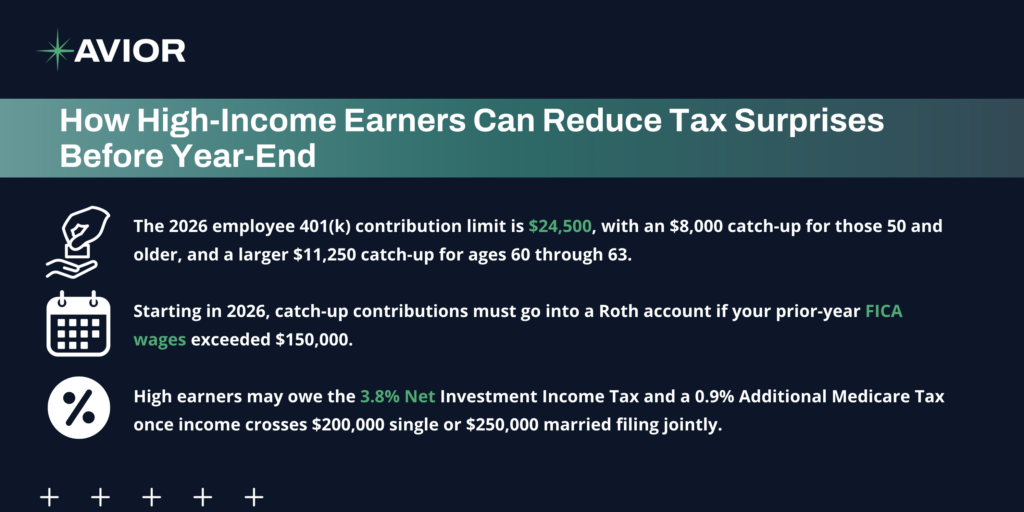
- The 2026 employee 401(k) contribution limit is $24,500, with an $8,000 catch-up for those 50 and older, and a larger $11,250 catch-up for ages 60 through 63.
- Starting in 2026, catch-up contributions must go into a Roth account if your prior-year FICA wages exceeded $150,000.
- High earners may owe the 3.8% Net Investment Income Tax and a 0.9% Additional Medicare Tax once income crosses $200,000 single or $250,000 married filing jointly.
- Net capital losses beyond your gains can offset up to $3,000 of ordinary income per year, with the rest carrying forward indefinitely.
- The prior-year safe harbor for avoiding an underpayment penalty rises to 110% of last year’s tax when your adjusted gross income tops $150,000.
Why Do Tax Surprises Hit High Earners Hardest?
Higher incomes carry more moving parts, and each one can shift your liability in ways that compound. A bonus, equity compensation that vests, a profitable asset sale, and self-employment income all stack on top of wages, sometimes pushing you into a higher bracket or across a threshold you did not see coming. The more income sources you hold, the harder the final number is to predict without a deliberate projection.
Several surtaxes apply only at higher income levels, which is why affluent households face exposures that most taxpayers never encounter. The 3.8% Net Investment Income Tax applies to investment earnings once modified adjusted gross income exceeds $200,000 for single filers or $250,000 for married couples filing jointly. A separate 0.9% Additional Medicare Tax kicks in at those same income points on wages and self-employment income. Neither shows up on a paycheck stub the way ordinary withholding does, so both tend to surprise people at filing.
The fix begins with visibility. Running a full-year income estimate in the fall, while two or three months of action time remain, lets you see which thresholds you are approaching and decide whether to accelerate, defer, or offset income before the year ends.

Which Contributions Should You Maximize First?
Funding tax-advantaged accounts is among the most reliable ways to lower taxable income, and the 2026 limits give high earners meaningful room. Maximizing these before year-end captures the benefit for the current tax year, since most contribution windows close with the calendar.
- 401(k) and similar plans: The employee deferral limit is $24,500 for 2026. Those 50 and older can add an $8,000 catch-up, and savers aged 60 through 63 can use a larger $11,250 catch-up if their plan allows it.
- Health savings accounts: For 2026 you can contribute $4,400 for self-only coverage or $8,750 for family coverage, plus a $1,000 catch-up at age 55 and older. An HSA offers a deduction now, tax-free growth, and tax-free withdrawals for qualified medical costs.
- Traditional IRAs: The limit is $7,500 for 2026, with a $1,100 catch-up at 50 and older, though deductibility phases out at higher incomes when you have a workplace plan.
One change deserves close attention. Beginning in 2026, if your prior-year FICA wages topped $150,000, any catch-up contribution must be made on a Roth, after-tax basis rather than pre-tax. Confirming how your plan handles this before the final payrolls run prevents a misdirected contribution and an unexpected paycheck change.
How Can You Time Income and Deductions on Purpose?
Timing is where year-end planning earns its keep. When you can influence when income lands or when a deduction is taken, you gain the ability to smooth your liability across tax years rather than absorbing a spike in one.
On the income side, you might ask an employer to defer a discretionary bonus into January, delay invoicing for self-employment work, or postpone a Roth conversion to a lower-income year. Each move can keep you below a bracket edge or a surtax threshold. The reverse applies in a year when your income is unusually low, where accelerating income to fill up a lower bracket can make sense.
Deductions follow the same logic in reverse. Bunching two years of charitable gifts into a single year, prepaying certain deductible expenses, or accelerating a planned medical procedure can lift you over the standard deduction in the year you itemize. A common approach alternates between a high-deduction year and a standard-deduction year, concentrating the tax benefit where it counts.
What Investment Moves Lower a Year-End Bill?

Your portfolio holds several levers that work only if you pull them before December 31. These tend to pair naturally with the income projection you have already run.
Tax-loss harvesting comes first for most investors. Selling positions that trade below your cost basis lets you realize losses that offset realized gains dollar for dollar, and net losses beyond your gains can reduce up to $3,000 of ordinary income per year. Any remainder carries forward to future years, so a down position can hold real planning value. Be mindful of the wash-sale rule, which disallows the loss if you repurchase the same security within 30 days.
Charitable giving offers two efficient routes for high earners:
- Donating appreciated securities held more than a year lets you deduct the fair market value while avoiding capital gains tax on the appreciation, which beats selling the stock and donating cash.
- Qualified charitable distributions let those 70½ and older give directly from an IRA, up to $111,000 per individual in 2026, excluding the amount from income and counting toward a required minimum distribution.
Required minimum distributions themselves warrant a year-end check for anyone subject to them. Missing the deadline triggers a steep penalty, so confirming the distribution is complete before the holidays protects against an avoidable cost.
Are Your Withholding and Estimated Payments Enough?
Paying the right amount through the year matters as much as lowering the liability itself, because underpayment carries its own penalty regardless of whether you pay in full at filing. The IRS charges interest on shortfalls, and the rate has hovered around 7 to 8% recently.
The safe harbor gives you a clear target. You generally avoid the penalty by paying the smaller of 90% of your current-year tax or a percentage of last year’s tax through withholding and estimates. For high earners, that prior-year figure rises to 110% of last year’s tax once your adjusted gross income exceeds $150,000, a detail many people miss when they assume 100% protects them.
A year-end withholding check can close any gap cleanly. Because withholding counts as paid evenly across the year even when it happens late, increasing your final paychecks’ withholding or making a fourth-quarter estimated payment can cure an underpayment that quarterly estimates alone would leave exposed.
Frequently Asked Questions
When should high earners start year-end tax planning?
Ideally by October or early November, when most of your income for the year is visible and two to three months remain to act. Waiting until December narrows your options, and waiting until filing season eliminates nearly all of them.
Does maxing out my 401(k) actually reduce my taxes?
Pre-tax 401(k) contributions lower your taxable income for the year, so they directly reduce your current bill. Roth contributions do not lower today’s taxes but provide tax-free growth and withdrawals later, which can matter more depending on your situation.
What is the Net Investment Income Tax and will I owe it?
It is a 3.8% surtax on investment income that applies once modified adjusted gross income passes $200,000 for single filers or $250,000 for joint filers. It applies to the lesser of your net investment income or the amount your income exceeds the threshold.
Is donating stock better than donating cash?
For appreciated securities held more than a year, often yes. You can generally deduct the full market value and avoid the capital gains tax you would owe by selling first, which makes each dollar given more tax-efficient than cash.
How do I avoid an underpayment penalty?
Pay through withholding and estimates either 90% of this year’s tax or 110% of last year’s tax if your AGI tops $150,000. A year-end withholding boost is often the cleanest fix, since withholding is treated as paid evenly across the year.
Work With Us
Reducing tax surprises is a function of timing and visibility. High earners who project income in the fall, maximize the 2026 contribution limits, time income and deductions across tax years, harvest losses and give strategically, and confirm their payments meet the safe harbor tend to reach filing season with no unwelcome figures waiting for them. Each of these moves interacts with the others, which is why looking at them together before December 31 produces far better results than addressing any one in isolation.
Avior coordinates investment management, tax planning, and accounting under one roof, so the strategies above work in concert rather than as disconnected decisions. Our advisors and tax professionals can run your full-year projection, identify the specific moves that fit your income picture, and execute them while the calendar still allows. If you want to close out the year with confidence rather than guesswork, schedule a call with our team.



No Comments
Sorry, the comment form is closed at this time.