


How to Prepare for College Costs Without Disrupting Your Investment Strategy
You can prepare for college costs without derailing your long-term investments by funding education through dedicated, tax-advantaged accounts like 529 plans, keeping retirement contributions at their baseline, and treating tuition as one line item inside a broader financial plan rather than an emergency that forces you to sell growth assets.
A college acceptance letter arrives with a quiet financial countdown attached. Suddenly the abstract number you half-remembered from a savings calculator becomes a tuition bill due in August, and the temptation grows to pull money from wherever it sits, including the portfolio that took two decades to build. Families who plan ahead rarely face that pressure, because they have already decided where the money will come from and which accounts stay untouched.
The stakes have climbed. For the 2025-2026 academic year, average published tuition and fees reached $11,950 at public in-state universities and $45,000 at private nonprofit colleges, and room and board can rival tuition itself. With costs at these levels, the order in which you fund goals matters as much as the total you save. A thoughtful approach lets you support a child’s education while your investment strategy keeps compounding in the background.
Key Takeaways
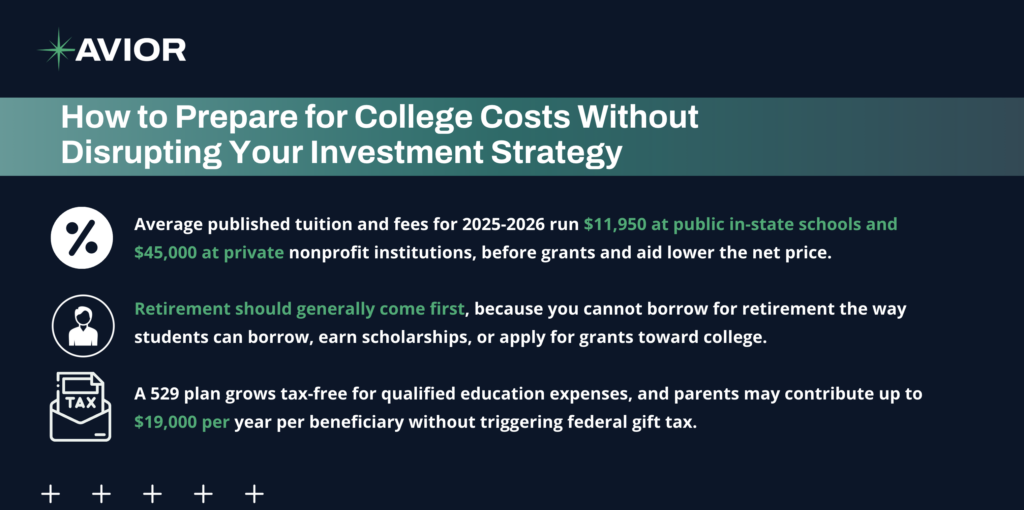
- Average published tuition and fees for 2025-2026 run $11,950 at public in-state schools and $45,000 at private nonprofit institutions, before grants and aid lower the net price.
- Retirement should generally come first, because you cannot borrow for retirement the way students can borrow, earn scholarships, or apply for grants toward college.
- A 529 plan grows tax-free for qualified education expenses, and parents may contribute up to $19,000 per year per beneficiary without triggering federal gift tax.
- Leftover 529 funds can roll into the beneficiary’s Roth IRA, up to a $35,000 lifetime limit, once the account has been open at least 15 years.
- Federal Parent PLUS borrowing tightens on July 1, 2026, with a new $20,000 annual cap and a $65,000 lifetime cap per dependent student.
- Selling appreciated investments to cover tuition can trigger capital gains taxes and forfeit years of compounding, so it usually works as a last resort rather than a plan.
Why Should Retirement Stay Ahead of College Savings?
Retirement comes first for a reason that holds up under almost every scenario. Your child has access to loans, grants, scholarships, and work-study to fund an education. No equivalent safety net exists for your later years, and lenders do not offer retirement income loans to people in their seventies.
Every dollar pulled from a retirement account in your peak earning years loses the compounding it would have earned over the following decades. A parent who sacrifices their own security may also become a financial responsibility for that same child later, which helps no one.
This does not mean abandoning college savings. It means sequencing. Capture your full employer match first, since that match is an immediate return no education account can replicate. Fund your baseline retirement target next. Direct what remains toward college, and you protect both goals at sustainable levels instead of gambling one against the other.
How Does a 529 Plan Protect Your Broader Portfolio?

A 529 plan keeps education money in its own lane, which is exactly what protects your investment strategy. Money you contribute grows tax-deferred, and withdrawals come out tax-free when used for qualified education expenses like tuition, fees, room, and board. That tax treatment means you generally avoid selling taxable investments and absorbing capital gains to pay a tuition bill.
The contribution room is generous. A parent may give up to $19,000 per year, per child, without federal gift tax consequences, and married couples can combine for more. Families who want to accelerate funding can front-load five years of gifts at once, contributing up to $95,000 per beneficiary in a single year through a technique sometimes called superfunding. Many states also offer their own income tax deduction or credit for 529 contributions, which adds a second layer of benefit for in-state savers.
Starting early compounds the advantage. A 529 opened when a child is young has 15 to 18 years to grow alongside your retirement accounts, and consistent contributions, even modest ones, can build a meaningful balance over that horizon. The earlier you begin, the less you need to set aside each month, and the less likely you are to reach for portfolio assets when bills arrive.
What If You Save Too Much in a 529?
Overfunding once worried families, and recent rules have eased that concern considerably. Leftover 529 funds can now roll into a Roth IRA owned by the plan’s beneficiary, up to a $35,000 lifetime cap, which gives unused education dollars a path toward the child’s retirement instead of a tax penalty.
The rules carry conditions worth knowing. The 529 account must have been open for at least 15 years, the funds being moved must have been in the account for at least five years, and the beneficiary needs earned income equal to the rollover amount. Each year’s transfer counts toward the annual Roth IRA contribution limit, which sits at $7,500 for 2026, so moving the full $35,000 takes several years. These rollovers also bypass the usual Roth income limits, a useful feature for higher-earning families.
When Does Borrowing Make Sense, and When Does It Backfire?
Borrowing for college can be reasonable when it preserves a sound retirement plan and the amounts stay modest relative to a graduate’s expected earnings. Federal student loans taken in the student’s name offer income-driven repayment options and protections that make them more flexible than many alternatives, and a student carrying a reasonable balance generally fares better than a parent who emptied a retirement account.
Parent borrowing deserves more caution, especially given upcoming changes. Starting July 1, 2026, Parent PLUS loans carry a $20,000 annual cap and a $65,000 lifetime cap per dependent, and borrowers under the new rules lose access to income-based repayment. A parent who takes on large balances in their fifties locks in payments during the exact window when retirement catch-up contributions matter most. The compounding lost in those final working years can dwarf the tuition the loan covered.
A balanced strategy uses education savings first, then current income, then reasonable student borrowing to fill any gap. Reducing retirement contributions below baseline sits at the bottom of the list, used only after other options are genuinely exhausted.
What Funding Sources Keep Your Investments Intact?

Several levers let you cover college without touching your core portfolio. Scholarships and grants, which made up 68% of the funds undergraduates used in a recent year according to College Board data, reduce the bill before you spend a dollar of your own. Filing the FAFSA early and applying broadly to merit aid can meaningfully shrink net cost, particularly at private schools that discount heavily off sticker price.
Current cash flow is another underused tool. Tuition is often payable in installments, and many colleges offer monthly payment plans that let families cover costs from income rather than liquidating assets. Grandparents can help too, since direct tuition payments to a school are exempt from gift tax entirely, and gifts into a 529 carry the same tax-free growth as parental contributions.
Choices about the school itself move the needle as much as any funding source. Two years at a community college before transferring to an in-state public university can cut the total cost of a bachelor’s degree substantially, and the diploma reads the same. Living at home, when feasible, may save a family well over ten thousand dollars a year in room and board. Each of these decisions reduces the pressure on your investment accounts.
Frequently Asked Questions
Should I stop contributing to my 401(k) to save for college?
In most cases, no. Maintaining retirement contributions, especially up to your employer match, generally takes priority because you can borrow for college but not for retirement. Reducing 401(k) contributions to fund tuition often costs more in lost compounding and forfeited matching than it saves.
Is a 529 plan better than a regular brokerage account for college?
For dedicated education savings, a 529 usually offers stronger tax advantages, since growth and qualified withdrawals are tax-free and many states add a deduction. A taxable brokerage account gives more flexibility but generates capital gains taxes when you sell to pay tuition, which can erode returns.
Can I use a Roth IRA to pay for college?
You can. The IRS allows penalty-free withdrawals from a Roth IRA for qualified education expenses, though you may owe tax on earnings withdrawn before age 59½. Some families use a Roth as a flexible vehicle that serves either education or retirement depending on how college costs unfold.
What happens to 529 money if my child gets a scholarship?
You have options. You can withdraw an amount equal to the scholarship without the usual 10% penalty on earnings, change the beneficiary to another family member, save the funds for graduate school, or roll up to $35,000 into the beneficiary’s Roth IRA over time if the account qualifies.
How much should I save for college without hurting my retirement?
There is no single figure, since it depends on your retirement progress, income, and timeline. A common framework funds retirement to your target first, captures the full employer match, then directs surplus toward a 529. A financial professional can model the trade-offs for your specific situation.
Work With Us
Preparing for college costs is, at its core, a sequencing problem. Families who fund retirement to their baseline, channel education savings into tax-advantaged accounts like 529 plans, lean on scholarships and current cash flow, and borrow only in measured amounts tend to send a child to college with their long-term investments still intact and compounding. The rising sticker prices, the 2026 changes to Parent PLUS borrowing, and the expanded flexibility of 529-to-Roth rollovers all reward planning done early rather than decisions made under deadline pressure.
Avior helps families weave college funding into a complete financial plan, so education goals and retirement goals support each other rather than compete. Our advisors can model how different savings rates, account types, and timelines affect both your child’s opportunities and your own future, and help you decide which assets to protect and which to deploy. If you would like a clear, personalized strategy for funding college while keeping your investments on track, schedule a consultation with our team.



No Comments
Sorry, the comment form is closed at this time.