


Retirement Income Planning for Affluent Families: Which Accounts Should You Draw From First?
For affluent families, the order in which retirement accounts are tapped can quietly determine how much wealth survives the next thirty years. The conventional wisdom of “taxable first, tax-deferred second, Roth last” works as a starting point for many households, but it tends to break down once the balance sheet involves multiple million-dollar accounts, concentrated holdings, and meaningful estate planning goals. At that scale, withdrawal sequencing becomes one of the highest-leverage decisions in the entire financial plan, and the wrong order can quietly cost six or seven figures over a long retirement.
The reason this matters more for affluent households is straightforward: the tax rates climb faster, the required minimum distribution figures get larger, and the planning horizon often extends well past the original account holder’s lifetime into a multi-generational frame. A retiree with $5 million across various account types faces a different optimization problem than someone with $500,000, and treating both with the same playbook tends to leave money on the table. The sections below walk through how to think about the sequencing question with the complexity these families actually face.
Key Takeaways
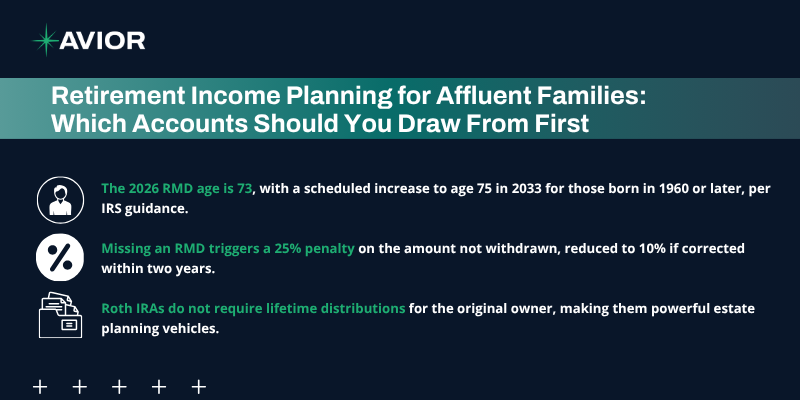
- The 2026 RMD age is 73, with a scheduled increase to age 75 in 2033 for those born in 1960 or later, per IRS guidance.
- Missing an RMD triggers a 25% penalty on the amount not withdrawn, reduced to 10% if corrected within two years.
- Roth IRAs do not require lifetime distributions for the original owner, making them powerful estate planning vehicles.
- Social Security delayed retirement credits add roughly 8% per year for each year benefits are postponed past full retirement age, capped at age 70.
- Full retirement age reaches 67 for those born in 1960 or later, taking effect in November 2026 per SSA rules.
- Long-term capital gains rates of 0%, 15%, or 20% apply to taxable accounts based on income, often producing lower tax bills than ordinary income withdrawals.
- The 2026 standard deduction is $32,200 for married couples filing jointly, which shapes how much taxable income can flow through at low rates.
Why Withdrawal Order Matters More Than Most People Realize
Different account types are taxed differently, and that creates room for strategy. Withdrawals from traditional IRAs and 401(k)s are taxed as ordinary income at rates up to 37% federally for high earners. Withdrawals from taxable brokerage accounts trigger capital gains taxes, often at the long-term rate of 15% or 20%. Roth IRA withdrawals, assuming the account has been open at least five years and the owner is over 59½, come out completely tax-free.
For an affluent household drawing $300,000 a year in retirement, the difference between pulling that entirely from a traditional IRA versus blending across account types can mean tens of thousands of dollars in annual tax savings. Multiplied across a thirty-year retirement, the gap may run well into seven figures. Sequencing is one of the few levers in retirement planning that produces this kind of compounding benefit without requiring any change in lifestyle.
How Should Affluent Families Think About the Drawdown Order?

The textbook answer is taxable first, then tax-deferred, then Roth. The textbook answer is incomplete for high-net-worth households. A more sophisticated framework looks at three things at once: current marginal tax bracket, future RMDs, and estate considerations.
The Conventional Sequence and Its Limits
The traditional approach makes sense for moderate-wealth retirees because it lets tax-deferred and tax-free accounts continue compounding while taxable accounts (which generate annual tax drag from dividends and interest) get drawn down first. This works well when the tax-deferred balance is modest enough that future RMDs do not push the retiree into uncomfortable brackets.
For affluent families, the math often flips. If a couple in their early sixties has $4 million in traditional IRAs, waiting until age 73 to start withdrawing may produce RMDs large enough to push them into the top federal bracket regardless of what else is happening in their lives. Drawing from those accounts earlier, even when working assets are still appreciating, may smooth lifetime taxes meaningfully.
Filling the Lower Brackets Strategically
A more refined approach involves looking at each year’s tax brackets and intentionally filling them. The 2026 federal brackets give a married couple meaningful room to recognize income before hitting higher rates. A retiree in their late sixties with relatively low Social Security income and minimal taxable account income may have substantial space to draw from traditional accounts at the 12% or 22% bracket rather than waiting for RMDs at 32% or higher.
This is sometimes called “bracket filling” or “tax bracket management.” Done consistently, it can move significant amounts out of tax-deferred accounts at relatively low rates, reducing the eventual RMD burden and the overall lifetime tax bill.
Roth Conversions in the Gap Years
The years between retirement and the start of RMDs at age 73 often represent the lowest-income years of an affluent household’s life. Wages have stopped, Social Security may not have started, and RMDs have not yet begun. These gap years may be ideal for Roth conversions, which permanently move money from tax-deferred to tax-free status.
Hypothetical example: a couple retires at 65 with $3 million in traditional IRAs and decides to delay Social Security until 70. During those five gap years, they could convert $200,000 to $300,000 annually to a Roth, paying tax at brackets they may never see again. (These figures are illustrative only.) The result is a lower future RMD burden, larger tax-free assets, and more flexibility for heirs.
Where Does Social Security Fit in the Sequence?
Social Security is its own form of asset, and timing the claim affects every other withdrawal decision. Per the Social Security Administration, monthly benefits increase by approximately 8% per year for each year benefits are delayed past full retirement age, up to age 70. The increase stops accumulating after 70.
Why Delaying Often Benefits Affluent Households
For households with substantial retirement savings, the question is rarely whether they need Social Security at 62 to pay bills. The question is whether the larger guaranteed income stream from delaying makes more sense than claiming early and leaving investment assets untouched. A married couple with strong longevity expectations and meaningful taxable assets may find that delaying both spouses’ benefits to 70 produces a higher lifetime income stream and reduces the pressure on the portfolio in later years.
The break-even point typically lands around age 80 to 82, meaning households who expect to live past that point may benefit more from delay. For couples, the survivor benefit calculation strengthens the case further, since the surviving spouse keeps the higher of the two benefits for life.
Coordinating Social Security with Withdrawals
When Social Security is delayed, the gap years between retirement and benefit claiming need to be funded somehow. This is where a coordinated drawdown plan matters. Pulling from taxable accounts during these years, possibly while running Roth conversions in the same period, may produce a particularly efficient tax outcome. The lower income years used for conversions can also temporarily reduce the percentage of Social Security benefits that becomes taxable once it does start.
What About Estate and Legacy Considerations?
For affluent families thinking about wealth transfer, the drawdown order interacts with what beneficiaries will eventually receive.
Roth Accounts as Estate Planning Tools
Roth IRAs are often described as the most efficient inheritance vehicle in the tax code. The original owner takes no required distributions, the assets continue growing tax-free, and beneficiaries (other than spouses) face only the 10-year distribution rule rather than ordinary income tax. Many affluent families intentionally preserve Roth balances and draw more heavily from traditional accounts during their own lifetimes for exactly this reason.
The Step-Up in Basis on Taxable Accounts
Taxable brokerage accounts receive a step-up in basis at death, meaning heirs inherit assets at current market value with the embedded capital gains erased. This creates a planning opportunity that runs in tension with the conventional “taxable first” advice. Holding highly appreciated taxable positions for the next generation while drawing from other accounts may be more tax-efficient overall, especially for assets the family does not need for living expenses.
The Inherited IRA 10-Year Rule
Most non-spouse beneficiaries of traditional IRAs must now empty the inherited account within 10 years of the original owner’s death, often during their own peak earning years. This compressed window can push large amounts of taxable income into high brackets. The original account holder’s drawdown choices, especially Roth conversions, directly affect how painful this becomes for the next generation.
Frequently Asked Questions
Should I always draw from taxable accounts first?
Probably not at higher wealth levels. Affluent families often benefit from a blended approach that draws strategically from multiple account types each year to manage brackets and future RMDs.
What if I do not need any retirement income from my accounts?
RMDs at age 73 still apply regardless of need. Households who do not need the income may consider qualified charitable distributions directly from an IRA, which satisfy the RMD without generating taxable income.
How does delaying Social Security affect my withdrawal strategy?
Delaying typically increases withdrawals from other accounts during the gap years, but the larger Social Security benefit later may permanently reduce the pressure on the portfolio.
Can I still contribute to a Roth IRA in retirement?
Roth contributions require earned income. Roth conversions, however, do not, which is why conversions become the primary tool for moving assets to Roth status during retirement.
Does the SECURE 2.0 Act change anything for high earners?
Yes. Several provisions affect high-income households, including changes to catch-up contribution rules and the elimination of pre-death RMDs from Roth balances inside employer plans. These shifts may influence both accumulation and withdrawal strategies.
Work With Us
Withdrawal sequencing for affluent families involves balancing current tax brackets, future RMDs, Social Security timing, and estate considerations all at once, and the right answer rarely matches the textbook version. A coordinated strategy that uses the gap years for Roth conversions, fills lower brackets intentionally, delays Social Security where it makes sense, and preserves tax-advantaged assets for heirs may produce dramatically better lifetime outcomes than a default sequence applied without thought. The complexity is real, but so is the opportunity, and the families who treat sequencing as a strategic decision rather than a default rule tend to capture the difference.
At Avior, we help affluent families build retirement income strategies that integrate tax planning, Social Security timing, RMD management, Roth conversion analysis, and estate coordination into a single coherent plan. Our team works alongside your CPA and estate attorney to model the multi-decade tax consequences of different sequencing choices, so the order you draw from your accounts reflects the full picture rather than any single piece of it. If you are approaching retirement or already there and want a closer look at your withdrawal strategy, we would welcome the conversation .Schedule a consultation to get started.



No Comments
Sorry, the comment form is closed at this time.