


How High Net Worth Investors Should Think About Portfolio Rebalancing in Volatile Markets
Portfolio rebalancing in volatile markets is the disciplined process of selling positions that have drifted above target weights and buying those that have fallen below, using a rules-based framework that removes emotion from the decision and respects the tax and liquidity realities of a larger balance sheet.
For high net worth investors, the stakes of getting this right are different than for the average household, because the dollar amounts involved turn small percentage swings into six and seven figure shifts, and the tax consequences of an ill-timed trade can dwarf the cost of simply rebalancing a few months earlier.
Volatility tends to reveal which portfolios were actually built for turbulence and which only looked sturdy in calm water. Over the past year, the CBOE Volatility Index has swung from lows near 13 to highs above 35, a range that tests the nerves of even seasoned investors. The temptation during those swings is to either freeze or overreact, and both responses can erode long-term outcomes. The sections below lay out a more considered approach, one built around discipline, tax awareness, and the specific complexities that come with substantial wealth.
Key Takeaways
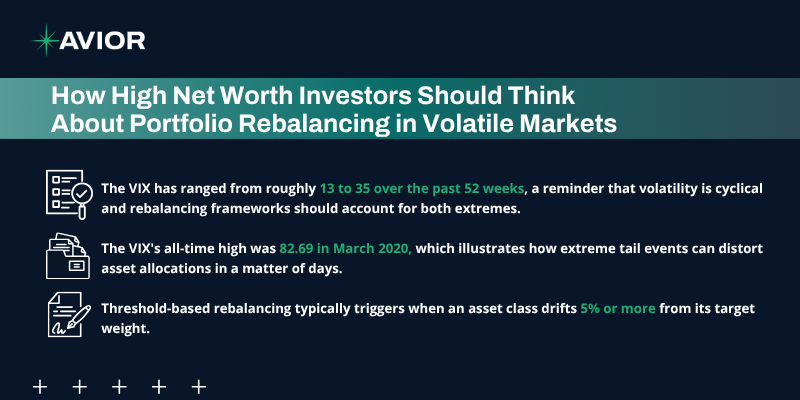
- The VIX has ranged from roughly 13 to 35 over the past 52 weeks, a reminder that volatility is cyclical and rebalancing frameworks should account for both extremes.
- The VIX’s all-time high was 82.69 in March 2020, which illustrates how extreme tail events can distort asset allocations in a matter of days.
- Threshold-based rebalancing typically triggers when an asset class drifts 5% or more from its target weight.
- Calendar-based rebalancing on an annual or semi-annual schedule may be sufficient for many portfolios.
- Long-term capital gains rates of 0%, 15%, or 20% apply to assets held more than one year, while short-term gains are taxed as ordinary income.
- Tax-advantaged accounts (IRAs, 401(k)s, HSAs) can absorb rebalancing trades without triggering immediate tax consequences.
- Hybrid rebalancing combines calendar checkpoints with threshold triggers and may offer the best of both approaches for complex portfolios.
Why Volatility Actually Helps Disciplined Rebalancers
Volatile markets create larger gaps between target allocations and actual weights, which is the raw material rebalancing works with. When equities surge and fixed income lags, a 60/40 portfolio can quickly drift to 70/30 without the investor lifting a finger. The reverse also happens during sharp drawdowns. These drifts are the opportunity, because the mechanical act of selling what has outperformed and buying what has underperformed is a structural version of buying low and selling high.
According to Investopedia, no single rebalancing strategy has historically outperformed all others, and the most important factor is settling on a rule you can stick with. For high net worth portfolios, the rule needs to be robust enough to handle complexity yet simple enough to execute without hesitation when markets are swinging.
What Rebalancing Approach Fits a High Net Worth Portfolio?
Three approaches dominate the field: calendar-based, threshold-based, and hybrid. Each has tradeoffs that look different at scale.
Calendar-Based Rebalancing
The simplest approach involves reviewing allocations on a fixed schedule, whether quarterly, semi-annually, or annually. Vanguard research suggests that for many investors, an annual rebalance may be optimal, since more frequent rebalancing increases transaction costs without meaningfully improving outcomes, and less frequent rebalancing allows the portfolio to drift too far from target.
The advantage of a calendar approach is predictability. The disadvantage is that it ignores market conditions entirely. A portfolio that hit its review date in early March 2020, when the VIX spiked to 82.69, would have faced very different decisions than one reviewed in a quiet February. For larger portfolios, rigid calendar adherence can mean missing significant rebalancing opportunities or forcing trades at inopportune moments.
Threshold-Based Rebalancing
Threshold-based rebalancing triggers only when an asset class deviates from its target by a set percentage, often 5%. A portfolio with a 60% equity target would rebalance when equities climbed above 65% or fell below 55%. This approach responds to market conditions rather than ignoring them, which may produce better outcomes during periods of extreme volatility.
The drawback for high net worth investors is the monitoring burden. Threshold strategies require regular portfolio review, and the transaction costs and tax consequences of more frequent trading can be meaningful at scale. Using tighter thresholds in volatile environments and looser thresholds in quiet markets is one way to balance responsiveness with efficiency.
Hybrid Approaches
Most larger portfolios benefit from combining both methods. A hybrid approach sets a regular review cadence (perhaps quarterly) but only executes trades when thresholds are breached. This captures the discipline of a schedule while avoiding unnecessary trades when markets are behaving normally. For complex portfolios with multiple asset classes, geographic exposures, and alternative investments, hybrid rebalancing may offer more flexibility than either pure approach.
How Do You Rebalance Without Creating a Tax Mess?

For taxable accounts, every rebalancing trade is potentially a taxable event. At scale, this matters enormously. A $5 million portfolio that needs to sell $500,000 of appreciated equities to rebalance could generate a substantial capital gains bill. The long-term capital gains rates of 0%, 15%, or 20% apply to positions held more than a year, while anything held less than a year is taxed as ordinary income, which for high earners can mean the difference between a 20% rate and a 37% rate.
Use Tax-Advantaged Accounts for the Heaviest Lifting
Rebalancing trades executed inside IRAs, 401(k)s, and similar accounts do not generate current-year tax consequences. Where possible, larger allocation shifts should happen in these accounts first. A hypothetical example: if a household holds $2 million in a taxable account and $2 million in tax-deferred accounts, rebalancing the tax-deferred side can often bring the overall portfolio back to target without touching the taxable side at all. (These figures are hypothetical and illustrative only.)
Harvest Losses Alongside Rebalancing
Volatile markets tend to produce pockets of underperformance even within diversified portfolios. Selling losing positions to offset gains realized elsewhere can soften the tax impact of rebalancing significantly. Losses can offset gains dollar for dollar, with up to $3,000 of excess losses deductible against ordinary income each year and the remainder carried forward indefinitely, per IRS guidance.
Redirect New Cash Flow Toward Underweights
Rather than selling overweighted positions, directing new contributions, dividends, interest, and required minimum distributions toward underweighted asset classes gradually restores balance without triggering capital gains. This strategy works especially well for larger portfolios with steady income streams, because the cash flow often does meaningful work over time.
What Complications Do High Net Worth Investors Face?
The complexity multiplies as wealth grows. Several issues deserve particular attention in volatile markets.
Concentrated Positions
A concentrated stock position, whether from a long career at one company or an inherited holding, can create outsized portfolio risk during volatility. Rebalancing often means reducing that position, which may trigger substantial capital gains and, in some cases, complicated considerations around trading windows or contractual restrictions. Strategies like exchange funds, charitable remainder trusts, or structured hedging may help manage the transition.
Alternative Investments and Illiquidity
Private equity, hedge funds, real estate partnerships, and other illiquid holdings do not rebalance easily. Their valuations may update quarterly at best, and exiting positions often requires patience and sometimes discounts. Rebalancing frameworks need to account for which portions of the portfolio are actually liquid and which are effectively fixed for the medium term.
Multi-Entity Complexity
High net worth portfolios often span individual accounts, joint accounts, trusts, family partnerships, and business interests. Rebalancing decisions made in isolation at the account level can produce suboptimal outcomes at the household level. A coordinated view across all entities, with attention to which account holds which asset for which reason, tends to produce better results.
Frequently Asked Questions
How often should I rebalance during a volatile market?
The most common suggestion is annual or semi-annual calendar rebalancing paired with threshold triggers works well for most investors. Volatile markets may produce more frequent threshold breaches, which is the system working as designed.
Should I try to time rebalancing to market conditions?
Attempting to predict short-term market direction tends to produce worse outcomes than sticking to a disciplined rule. Rebalancing is about risk management, not market timing.
Does rebalancing hurt returns during a bull market?
Rebalancing may reduce returns during sustained bull markets because it involves trimming winners. It also reduces risk, which typically matters more during drawdowns than during rallies.
What if volatility spikes right when my rebalance is due?
A spike in volatility often coincides with the best rebalancing opportunities, because asset weights have drifted the most. Sticking to the plan may feel uncomfortable but tends to produce better long-term outcomes.
Should I factor in the VIX directly when deciding to rebalance?
The VIX may inform how aggressive to be with threshold widths, but using it as a direct trigger risks turning rebalancing into market timing. Most disciplined approaches use VIX levels as context rather than a rule.
Work With Us
Portfolio rebalancing in volatile markets comes down to building a rules-based framework that respects both the discipline required to sell winners and buy underperformers, and the tax and liquidity complexities that come with substantial wealth. Whether through calendar schedules, threshold triggers, or a hybrid approach, the goal is to maintain the risk profile you actually chose rather than the one market movements have quietly imposed on you. For high net worth investors, layering in tax awareness, concentrated position management, and multi-entity coordination can mean the difference between a rebalancing strategy that adds value and one that quietly subtracts it.
At Avior, we help high net worth families and individuals build rebalancing frameworks tailored to the full complexity of their financial lives. Our team integrates tax coordination, estate considerations, concentrated position strategies, and alternative investment holdings into a single view, so that rebalancing decisions serve the entire plan rather than any one account. If recent market volatility has you wondering whether your allocation still reflects your goals, we would welcome the opportunity to take a closer look. Schedule a consultation to get started.



No Comments
Sorry, the comment form is closed at this time.