


How to Use Lifetime Gifting Strategically Without Disrupting Your Financial Plan
Lifetime gifting lets you transfer wealth to loved ones during your lifetime using the $19,000 annual exclusion and $15 million lifetime exemption for 2026, while reducing future estate tax exposure, as long as your gifts are calibrated to preserve your own retirement income and long-term security. That last part tends to be where good intentions run into trouble. Generosity feels timeless, but cash flow does not, and the gap between what you can afford to give today and what you may need in twenty years often looks wider than people assume.
The strategic question is rarely whether to give. It is how much, to whom, through which vehicle, and on what schedule, all without hollowing out the plan that funds your own future. Done well, lifetime gifting becomes a quiet force multiplier that moves appreciating assets out of your estate, teaches the next generation how to steward money, and keeps you firmly in control of your lifestyle. Done poorly, it creates regret that is hard to reverse. The sections below walk through the framework that helps families get this right.
Key Takeaways
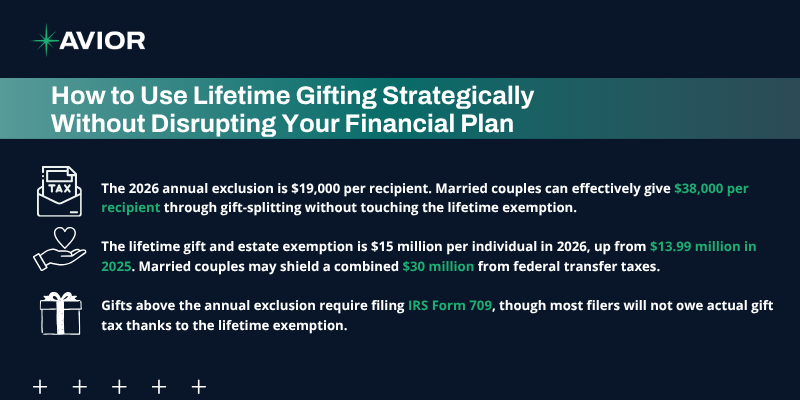
- The 2026 annual exclusion is $19,000 per recipient. Married couples can effectively give $38,000 per recipient through gift-splitting without touching the lifetime exemption.
- The lifetime gift and estate exemption is $15 million per individual in 2026, up from $13.99 million in 2025. Married couples may shield a combined $30 million from federal transfer taxes.
- Direct tuition and medical payments do not count against your exclusions when paid directly to the institution or provider.
- Gifts above the annual exclusion require filing IRS Form 709, though most filers will not owe actual gift tax thanks to the lifetime exemption.
- Amounts transferred above the lifetime exemption are taxed at a 40% federal rate.
- Gifting appreciating assets early shifts future growth out of your taxable estate, which can meaningfully compound the benefit over time.
- Retirement feasibility must come first. A stress-tested cash flow plan should precede any large gifting decision.
Why Lifetime Gifting Matters More Than It Used To
The 2026 exemption numbers changed the calculus for a lot of families. The One Big Beautiful Bill Act raised the lifetime gift and estate exemption to $15 million per person, which the IRS confirmed in Revenue Procedure 2025-32, and made that figure permanent while keeping it indexed to inflation. That gives couples with significant estates a wider runway to plan, though the 40% rate above the exemption still applies, and state-level estate taxes remain a concern in many jurisdictions.
There is also a timing dimension. Moving high-growth assets out of your estate today means the appreciation happens in the recipient’s hands, not yours, which could compound into a meaningful tax benefit over a decade or two. For families with businesses, concentrated stock, or real estate holdings expected to rise in value, lifetime gifting may be one of the more efficient levers available.
How Do You Know If You Can Actually Afford to Gift?
Before any dollar leaves your portfolio, the feasibility question needs an honest answer. The first step before gifting heirs is to run a short analysis to confirm you have the income you need for the rest of your life. That framing still holds.
Stress-Test Your Retirement Income First
A proper feasibility review projects your income and expenses across multiple scenarios: longer-than-expected lifespans, a market downturn in the first five years of retirement, higher healthcare costs, and meaningful inflation. If the plan holds up under those pressures with a reasonable cushion, gifting becomes a live option. If it does not, the conversation may need to shift toward smaller annual gifts rather than large lump sums.
Cash flow projections are the workhorse tool here. They show how gifting shapes your liquidity year by year, which is often more useful than a static net worth snapshot. The goal is to identify a gifting capacity that is defensible under stress, not just comfortable in good markets.
Separate Lifestyle Capital from Legacy Capital
Many families find it helpful to mentally segment their assets into what supports their lifestyle and what could reasonably move to heirs. Lifestyle capital covers income needs, healthcare reserves, and a meaningful buffer. Legacy capital is what remains. Gifting decisions work best when they come from the legacy bucket, which may keep generosity from quietly eroding your security.
Which Gifting Strategies Fit a Strong Financial Plan?

Most families benefit from a blend of approaches rather than a single tactic. The right mix depends on your exemption usage, the assets you hold, and the needs of your recipients.
Annual Exclusion Gifts
The simplest approach is consistent use of the $19,000 annual exclusion per recipient. A hypothetical example: a couple with three adult children and five grandchildren could transfer roughly $304,000 in a single year using gift-splitting at $38,000 per recipient, with no Form 709 filing and no reduction of the lifetime exemption. Over a decade, that adds up.
Consistency matters more than size. A disciplined annual gifting rhythm, funded early in the year when possible, may quietly reshape your taxable estate without requiring any sophisticated structures.
Direct Payments for Tuition and Medical Expenses
Payments made directly to a school or medical provider are excluded from gift tax entirely and do not reduce your lifetime exemption. For example, paying a grandchild’s $50,000 college tuition directly to the university still leaves your full $19,000 annual exclusion available for that same grandchild. The strategy works for K–12 tuition, university costs, and most medical bills, though it covers tuition only and not room, board, or supplies.
Gifting Appreciating Assets
Transferring assets that are likely to grow, such as stock in a closely held business or real estate in a developing area, may be more efficient than gifting cash. The recipient takes on your cost basis, so capital gains implications should be weighed carefully, but the future appreciation occurs outside your estate. Fidelity notes that lifetime gifts above the annual exclusion reduce the estate exemption dollar for dollar, which means the timing and valuation of asset gifts deserves close attention.
Trust-Based Gifting for Control and Protection
For families who want to give substantially but worry about how recipients will handle large sums, irrevocable trusts offer a middle path. Assets can be moved out of the taxable estate while distribution terms are controlled through the trust document. The structure is less flexible than outright gifting, so it typically suits families with clearer long-range objectives. A qualified estate attorney should design the trust in coordination with your financial plan.
How Do You Avoid Disrupting Your Plan?
Most gifting missteps come from three places: giving too much too soon, ignoring tax and cash flow ripple effects, and neglecting to communicate with heirs.
Pace Your Gifts Against Real-Time Plan Performance
A gifting schedule that felt comfortable five years ago may not fit today’s circumstances. Annual reviews tied to actual portfolio performance, spending patterns, and health changes help keep your plan grounded. If a sequence of poor market years shows up, slowing the pace of gifts for a cycle or two may protect long-term feasibility.
Coordinate with Tax and Estate Professionals
Gifting decisions touch income tax, capital gains, estate tax, and sometimes generation-skipping transfer tax, which also carries a $15 million exemption in 2026. These threads tangle quickly. A coordinated team that includes your financial advisor, CPA, and estate attorney tends to produce better outcomes than isolated decisions.
Communicate with the Next Generation
A survey found that only 39 percent of those leaving an inheritance have provided guidance or direction to their beneficiaries about their intentions for the wealth. That gap produces confusion and, in some cases, friction that could have been avoided. Family conversations about the purpose of gifts, the expectations attached to them, and the broader plan tend to pay dividends that exceed the tax benefits.
Frequently Asked Questions
What happens if I gift more than $19,000 to one person in 2026?
You will need to file IRS Form 709 by April 15 of the following year, but you will likely not owe any tax. The excess amount reduces your lifetime exemption rather than triggering an immediate gift tax.
Do gifts to my spouse count against my exemption?
Gifts between U.S. citizen spouses qualify for the unlimited marital deduction and do not trigger gift tax or reduce your lifetime exemption. For a non-citizen spouse, the 2026 annual exclusion is $194,000.
Are charitable gifts subject to gift tax?
Gifts to qualified 501(c)(3) charities are excluded from gift tax and may also generate an income tax deduction if you itemize.
Can I change my mind after making a gift?
Once a gift is complete, it generally cannot be recalled. This is why feasibility analysis and pacing matter so much. Irrevocable structures amplify this concern.
Should I use the full $15 million lifetime exemption now?
That depends on your estate size, projected growth, health, and state-level tax exposure. For many families, using a portion of the exemption strategically may be more appropriate than front-loading the entire amount.
Work With Us
Lifetime gifting, at its best, is a quiet coordination exercise. The 2026 rules give families real room to operate with a $19,000 annual exclusion and a $15 million lifetime exemption, and the right mix of annual gifts, direct tuition and medical payments, appreciating asset transfers, and trust structures can move meaningful wealth to the next generation while trimming your future estate tax exposure. The catch is that every lever pulls against your own cash flow, your tax picture, and your long-range plan, which means the strategy only works when it is built on a stress-tested foundation and maintained with regular reviews.
At Avior, we help families integrate lifetime gifting into a comprehensive plan that accounts for retirement income, tax efficiency, estate coordination, and family communication. Our team works alongside your CPA and estate attorney to size the strategy to your actual capacity, pace the gifts against real-time plan performance, and keep the structure responsive as your circumstances evolve. If you are weighing how much to give, when to give it, or which vehicle fits your goals, we would welcome the opportunity to help. Schedule a consultation to get started.



No Comments
Sorry, the comment form is closed at this time.