


When Should a Business Owner Start Succession Planning?
The short answer is earlier than you think. Most business owners spend years perfecting their operations, building client relationships, and growing revenue. Succession planning, though, tends to sit at the bottom of the to-do list, filed somewhere between “eventually” and “when I get around to it.” That delay carries real risk. According to a 2025 U.S. Bank survey, only 54% of small business owners have a formal succession plan in place, even though more than half of U.S. small business owners are already over age 55. When a transition happens without preparation, whether through retirement, illness, or an unexpected event, the consequences can ripple through the business, the employees, and the owner’s personal finances all at once.
The question of timing is significant because succession planning touches almost every part of a financial plan. Valuation, tax strategy, estate planning, insurance, retirement income, and the future of your workforce are all connected to how and when you hand off the business. Waiting until you’re ready to walk away usually means compressing years of preparation into months, and that kind of pressure rarely produces the best outcome. The owners who tend to come out ahead are the ones who started the conversation long before they needed to act on it.
Key Takeaways
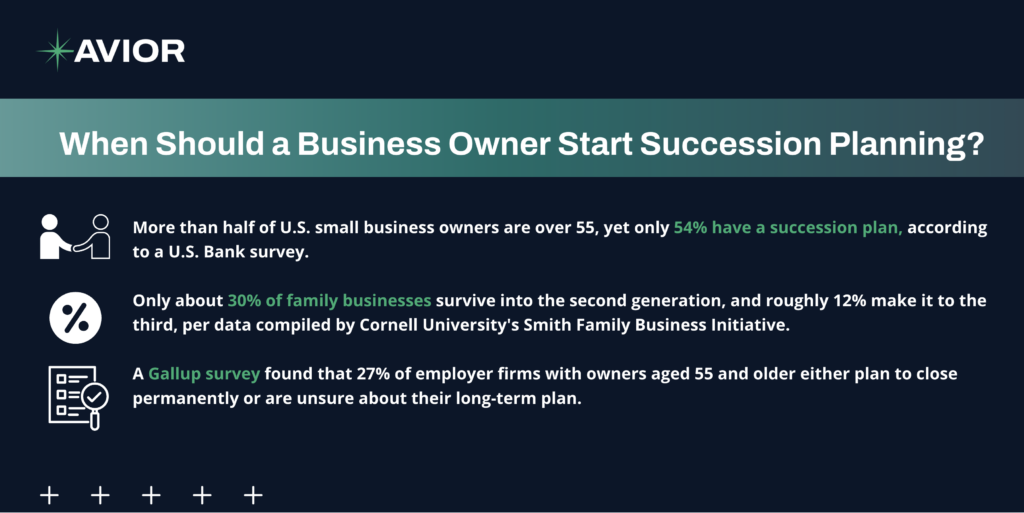
- More than half of U.S. small business owners are over 55, yet only 54% have a succession plan, according to a U.S. Bank survey.
- Only about 30% of family businesses survive into the second generation, and roughly 12% make it to the third, per data compiled by Cornell University’s Smith Family Business Initiative.
- A Gallup survey found that 27% of employer firms with owners aged 55 and older either plan to close permanently or are unsure about their long-term plan.
- The federal estate tax exemption for 2026 is $15 million per individual, and the qualified business income deduction has been made permanent under recent legislation, both of which may affect how owners structure a transition.
- Succession planning should ideally begin three to five years before the intended exit, allowing time for business valuation, tax optimization, successor development, and a thoughtful transition of client relationships.
Why So Many Owners Wait Too Long
It’s easy to understand the delay. Running a business demands constant attention, and the daily operational grind can push long-term planning out of sight. But the numbers tell a cautionary story. An analysis found that approximately 6% of all business closures occur because of owner illness or death, and an additional 7% happen when owners exit to pursue new ventures without a buyer in place. Many of these closures could have been avoided with earlier preparation.
The Emotional Barrier
For many founders, the business is deeply personal. It represents decades of sacrifice, identity, and community standing. Talking about who takes over can feel like an admission that the end is approaching. A U.S. Bank survey found that 62% of business owners describe the succession process as overwhelming. That emotional weight is real, and acknowledging it is the first step toward moving past it.
The “Too Early” Trap
Research indicates that 63% of business owners say it’s “too early” to begin succession planning, while 45% say they’re “too busy.” The irony is that starting early is precisely what gives owners the most control over the outcome. Waiting until the pressure mounts often means accepting terms, timelines, and valuations that fall short of what careful planning could have achieved.
The Financial Case for Starting Early
Succession planning affects the owner’s financial picture in ways that go well beyond the sale price. Tax exposure, retirement income, estate transfer strategies, and even insurance coverage all depend on when and how the transition unfolds.
Maximizing Business Valuation
A business that depends entirely on its founder is worth less to a buyer than one with a strong management team, documented systems, and diversified client relationships. Building that kind of operational independence takes time. Owners who begin succession planning three to five years out can make targeted investments in leadership development, process documentation, and revenue diversification that could meaningfully increase what the business is worth when it’s time to sell or transfer.
Tax-Efficient Transitions
The federal estate and gift tax exemption now stands at $15 million per person for 2026, or $30 million for married couples. The qualified business income deduction for pass-through entities has been made permanent under the One Big Beautiful Bill Act. These provisions create a potentially favorable environment for business transitions, but taking full advantage requires advance planning. Gifting strategies, trust structures, installment sales, and buy-sell agreements all work best when they’re implemented well ahead of the actual transfer date. Rushed execution could mean leaving significant tax savings on the table.
Succession Options Every Owner Should Understand
There is no single right way to exit a business. The best approach depends on the owner’s financial goals, family dynamics, the nature of the business, and how much involvement the owner wants after the transition.
Family Transfers
Passing the business to a child or family member is often the preferred route. A survey found that 72% of family business leaders want to keep the business in the family. The challenge is that wanting a family transition and executing one successfully are two very different things. Only about 30% of family-owned businesses survive into the second generation, and roughly 12% make it to the third. Much of that attrition stems from inadequate preparation, unclear roles, and family conflicts that were never addressed before the transition began.
A well-structured family transfer could involve a gradual shift of ownership through gifting, a sale at fair market value funded by the business itself, or a combination of both. The key is giving the successor enough time to develop leadership skills, earn the respect of employees and clients, and understand the financial mechanics of running the operation.
Sale to a Third Party
Selling to an outside buyer, whether a strategic acquirer, a private equity firm, or an individual entrepreneur, can be an effective path to liquidity. But the marketplace for small businesses is competitive. The Exit Planning Institute estimates that only about 30% of small businesses that go to market actually sell. Owners who prepare their businesses in advance by cleaning up financials, reducing owner dependency, and demonstrating stable cash flow may stand a much better chance of attracting qualified buyers and commanding a fair price.
Internal Transfers and Employee Ownership
Selling to key employees or transitioning to an employee stock ownership plan (ESOP) can preserve the business culture while providing the owner with a structured exit. These arrangements often unfold over several years, with the purchase funded through future business earnings. They tend to work well when the owner has strong, capable managers already in place and wants to ensure continuity for employees and clients.
The Role of Estate and Financial Planning in Succession
Succession planning doesn’t operate in a vacuum. It intersects directly with the owner’s broader financial and estate plan. For many business owners, the company represents the majority of their personal net worth, which means the transition strategy has to account for retirement income, liquidity needs, and wealth transfer goals simultaneously.
Coordinating With Your Estate Plan
Buy-sell agreements, life insurance policies, and trust structures all play a role in a well-coordinated succession plan. A hypothetical example: consider a business owner in their late 50s who wants to transfer ownership to two of their three children. Without a clear agreement, the third child might feel shortchanged, and the estate could face disputes. A funded buy-sell agreement, combined with an equitable estate plan, could help address that tension before it becomes a conflict.
Retirement Income Planning
If the business is the owner’s primary retirement asset, the succession strategy needs to produce enough after-tax proceeds to fund the owner’s lifestyle for decades. That might mean structuring the sale as an installment note, using a charitable remainder trust for tax efficiency, or retaining a consulting arrangement for a few years after the formal transition. These decisions require careful modeling well before the exit date arrives.
When to Start: A Practical Timeline

There is no universal trigger, but several milestones should prompt serious conversations about succession.
Five or More Years Out
Begin by getting a professional business valuation. Identify potential successors, whether they are family members, key employees, or external candidates. Review your estate plan to ensure it aligns with your succession goals. This is also the time to address any operational weaknesses that could reduce the business’s value.
Three to Five Years Out
Start implementing the structural changes that will support a smooth transition. This might include formalizing management roles, diversifying client relationships away from the founder, and establishing buy-sell agreements or trust structures. Begin working with your financial advisor and tax professional to model different exit scenarios and their impact on your retirement income and tax liability.
One to Two Years Out
At this stage, the plan should be largely in place and execution should be underway. The successor should be actively leading day-to-day operations. Financing for a sale or transfer should be arranged. Final tax planning moves, such as strategic gifting or trust funding, should be completed. The focus shifts from planning to execution and communication, with clients, employees, and other stakeholders.
Work With Us
Succession planning is one of the most consequential decisions a business owner will make, and it works best as a gradual process rather than a last-minute scramble. Starting early gives you time to build the business’s value, prepare a successor, minimize tax exposure, and ensure your retirement is funded on your terms. The owners who treat succession as an ongoing part of their financial strategy, rather than a single event, tend to achieve better outcomes for themselves, their families, and the people who depend on the business every day.
At Avior, we work with business owners to connect succession planning with the rest of their financial picture, from tax strategy and estate planning to retirement income and investment management. Whether you’re five years from a transition or just starting to think about what comes next, our team can help you build a plan that reflects your goals and protects what you’ve built. Schedule a conversation with us to get started.



No Comments
Sorry, the comment form is closed at this time.