


How Insurance Fits Into a Larger Financial Plan
Most people buy insurance the same way they buy smoke detectors. They check the box, toss the paperwork in a drawer, and hope they never need it. The problem is that a smoke detector only has one job. Insurance, on the other hand, plays several roles inside a financial plan, from protecting your family’s income to preserving the wealth you’ve spent years building. When each policy exists in isolation, disconnected from your investment strategy, your estate plan, and your tax situation, you could end up overpaying for coverage you don’t need while leaving dangerous gaps in areas that actually matter.
According to the 2025 Insurance Barometer Study by LIMRA and Life Happens, 40% of American adults say they need more life insurance. Separately, the U.S. Bureau of Labor Statistics reports that in March 2025, 59% of private-industry workers had access to long-term disability insurance, meaning about 41% did not. These aren’t fringe statistics. They reflect a widespread tendency to treat insurance as an afterthought rather than a working component of a broader financial strategy. When insurance is properly integrated, though, it can do more than cover catastrophic loss. It can strengthen every other piece of your plan.
Key Takeaways
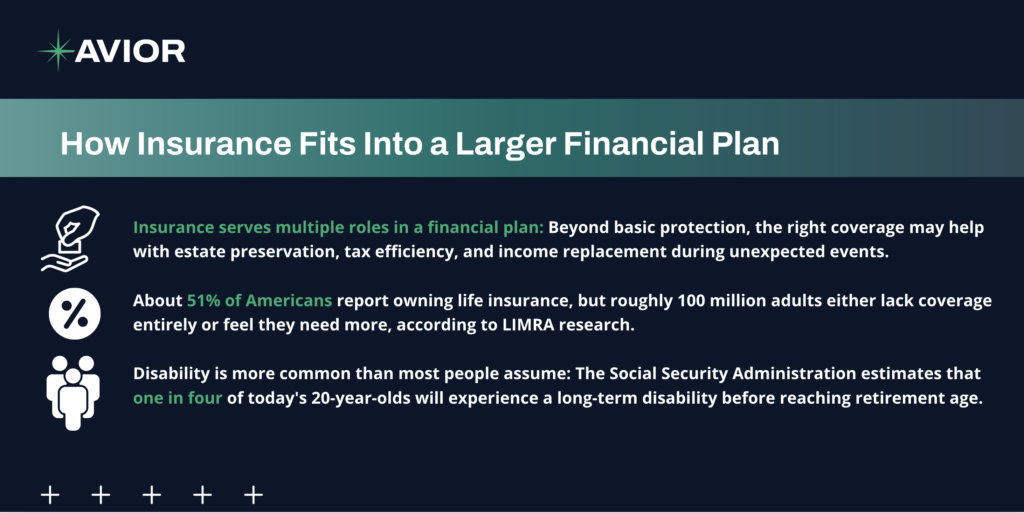
- Insurance serves multiple roles in a financial plan: Beyond basic protection, the right coverage may help with estate preservation, tax efficiency, and income replacement during unexpected events.
- About 51% of Americans report owning life insurance, but roughly 100 million adults either lack coverage entirely or feel they need more, according to LIMRA research.
- Disability is more common than most people assume: The Social Security Administration estimates that one in four of today’s 20-year-olds will experience a long-term disability before reaching retirement age.
- Life insurance can play a role in estate planning: Certain policy types may provide tax-advantaged wealth transfer and liquidity for estate expenses.
- Coordination matters more than any single policy: When insurance coverage aligns with your investment, tax, and estate strategies, the whole plan tends to work more efficiently.
Why Insurance Deserves a Seat at the Financial Planning Table
Too often, insurance conversations happen in a silo. You buy health coverage during open enrollment, pick up a term life policy when you have your first child, and maybe add an umbrella policy after buying a home. Each decision makes sense on its own. The issue is that nobody steps back to see how all those pieces fit together with your retirement savings, your tax bracket, and your long-term goals.
The Cost of Fragmented Coverage
When insurance decisions are made independently, overlaps and blind spots tend to multiply. A family might carry generous life insurance through an employer plan while having zero disability coverage. In that hypothetical scenario, the surviving family would be protected if the worst happened, but the household could be financially devastated by an extended illness or injury that prevents the primary earner from working. Financial plans work best when each component supports the others, and insurance is the layer that keeps everything from collapsing under pressure.
Life Insurance as a Financial Planning Tool
Life insurance is the most familiar form of coverage for most families, and for good reason. It provides a financial safety net if a breadwinner dies, covering mortgage payments, childcare expenses, education costs, and daily living needs. But the utility of life insurance extends well beyond that basic function, depending on the type of policy and how it fits within a broader strategy.
Term vs. Permanent: Different Tools for Different Jobs
Term life insurance covers a specific period, usually 10, 20, or 30 years, and is generally the most affordable way to secure a large death benefit. It may be well-suited for families with young children, a mortgage, or other time-limited obligations. When the term expires, the coverage ends.
Permanent life insurance, which includes whole life and universal life policies, lasts as long as premiums are paid and typically builds cash value over time. This cash value component could serve as a supplemental savings vehicle, a source of emergency liquidity, or even a tool for estate planning. For higher-net-worth individuals, a permanent policy held inside an irrevocable life insurance trust might help heirs cover estate taxes or provide a tax-free inheritance. The right choice depends on your specific situation, your goals, and what other assets are already part of your plan.
How Life Insurance Connects to Estate Planning
The federal estate tax exemption for 2026 stands at $15 million per person, or $30 million for married couples. Most families fall well below that threshold. But for those with larger estates, or for families with illiquid assets like real estate or a closely held business, life insurance could provide the cash needed to settle estate obligations without forcing a fire sale of property. Even for families below the federal threshold, some states impose their own estate or inheritance taxes at much lower levels, making life insurance a potentially useful piece of the planning puzzle.
Disability Insurance: Protecting Your Biggest Asset
Your ability to earn income is likely the most valuable financial asset you own. A 35-year-old earning $80,000 a year has roughly $2.5 million in future earnings between now and retirement, assuming modest raises. Losing that income stream, even temporarily, could disrupt savings contributions, mortgage payments, and every other financial commitment tied to a paycheck.
The Gap Most People Overlook
According to a report, only 43% of working Americans carried disability insurance. That leaves the majority of the workforce with little protection beyond what Social Security Disability Insurance provides, which averages roughly $1,582 per month for disabled workers. For most households, that amount would fall far short of covering even basic expenses.
How Disability Coverage Supports the Rest of Your Plan
When disability insurance is in place, the rest of your financial plan can function as intended. Your retirement contributions continue. Your emergency fund stays intact for actual emergencies. Your family avoids pulling from investment accounts at the worst possible time. Without it, a prolonged illness or injury could create a domino effect that takes years to recover from, assuming recovery is possible at all. Employer-provided group plans are a starting point, but they may cover only 60% of base salary and often exclude bonuses, commissions, and other compensation. A supplemental individual policy might help close that gap.
Health Insurance and Its Financial Ripple Effects

Health insurance might seem like the one coverage area that operates independently from financial planning. People choose plans based on premiums, deductibles, and provider networks. But the financial ripple effects of those choices extend further than most realize.
The Connection Between Health Coverage and Financial Stability
High-deductible health plans paired with a Health Savings Account (HSA) can serve double duty inside a financial plan. The HSA offers triple tax advantages: contributions are tax-deductible, growth is tax-free, and withdrawals for qualified medical expenses are tax-free as well. Over time, an HSA could accumulate meaningful savings that supplement retirement income for healthcare costs. Choosing the right health plan, in other words, is a financial planning decision that affects your tax liability, your savings rate, and your long-term preparedness.
Underinsurance Is a Growing Concern
Having a health plan doesn’t mean you’re adequately covered. According to Commonwealth Fund research, nearly one in four working-age adults were underinsured as of 2024, meaning their out-of-pocket costs or deductibles were high enough to discourage them from seeking timely care. That kind of coverage gap can lead to delayed treatments, larger medical bills down the road, and unexpected financial strain that spills into other areas of the plan.
Property, Liability, and Umbrella Coverage
Homeowners insurance and auto insurance get plenty of attention, but liability exposure is where the financial planning conversation gets more interesting. A standard homeowners or auto policy typically caps liability coverage at a few hundred thousand dollars. For families with meaningful assets, investment accounts, or business interests, a lawsuit or major accident could exceed those limits quickly.
An umbrella insurance policy provides an additional layer of liability protection, usually in increments of one million dollars, at a relatively modest cost. Think of it as a backstop that keeps a single event from undermining years of financial progress. The amount of umbrella coverage that may be appropriate depends on your total net worth, your exposure to risk, and the value of the assets you’re trying to protect.
Long-Term Care: Planning for the Expense Most People Ignore
Long-term care costs remain one of the largest unplanned expenses in retirement. Whether it involves assisted living, in-home care, or a skilled nursing facility, these services can consume savings at a startling rate. Traditional long-term care insurance can help offset those costs, though premiums have risen significantly in recent years and the product has become less straightforward.
Hybrid policies that combine life insurance with long-term care benefits have gained popularity as an alternative. These products may provide a death benefit if long-term care is never needed, while also covering care expenses if it is. For families concerned about protecting both their retirement savings and their legacy, a hybrid approach could offer flexibility. The key, as with every insurance decision, is making sure the coverage coordinates with the rest of the financial plan rather than existing as a standalone purchase.
Bringing It All Together: The Coordination Principle
Each type of insurance serves a specific purpose, but the real value comes from coordination. Life insurance protects your family and your estate. Disability coverage shields your income. Health insurance manages medical costs and, through vehicles like HSAs, contributes to long-term savings. Liability and umbrella coverage defend your assets. Long-term care planning preserves your retirement nest egg.
When all of these elements work together, they create a financial plan that can absorb unexpected events without falling apart. When they operate in isolation, each one carries hidden gaps that could expose your family to avoidable risk. A periodic review of your full insurance picture, alongside your investments, tax strategy, and estate documents, may be one of the highest-value exercises in financial planning.
Work With Us
Insurance is most effective when it functions as an integrated piece of a larger financial strategy. From life coverage that supports estate planning goals to disability protection that keeps retirement savings on track, each policy should serve a clear purpose within the broader picture. Treating insurance as a standalone checklist item could leave gaps that only become visible at the worst possible moment, when your family actually needs the protection.
At Avior, we help clients build financial plans where every component works in concert, including insurance, investments, tax strategy, and estate planning. If it has been a while since you’ve reviewed how your coverage fits within your overall financial picture, or if a life change has shifted your needs, our team can help you identify what’s working and what might need adjustment. Reach out to schedule a conversation and take the next step toward a more coordinated plan.



No Comments
Sorry, the comment form is closed at this time.