


Should You Use a 529 Plan, Trust, or Taxable Account for College Savings?
College costs have a way of arriving faster than anyone expects. One year you’re picking out a preschool, and the next you’re staring at tuition numbers that feel more like mortgage payments. According to research, average tuition and fees for the 2025-26 academic year hit $11,950 for in-state public universities and $45,000 for private nonprofits. Factor in room, board, books, and transportation, and four years at a public school runs roughly $124,000, while a private university could approach $262,000. Those totals demand a savings strategy that goes well beyond stashing money in a checking account and hoping for the best.
The question that families wrestle with is where to put the money. A 529 plan is the most well-known option, but trusts and taxable brokerage accounts each have advantages that a 529 can’t offer. The right vehicle depends on your family’s income, tax situation, financial aid considerations, and how much flexibility you want over the funds. In many cases, the best approach may involve a combination of accounts working together, each playing a distinct role in your overall financial plan.
Key Takeaways
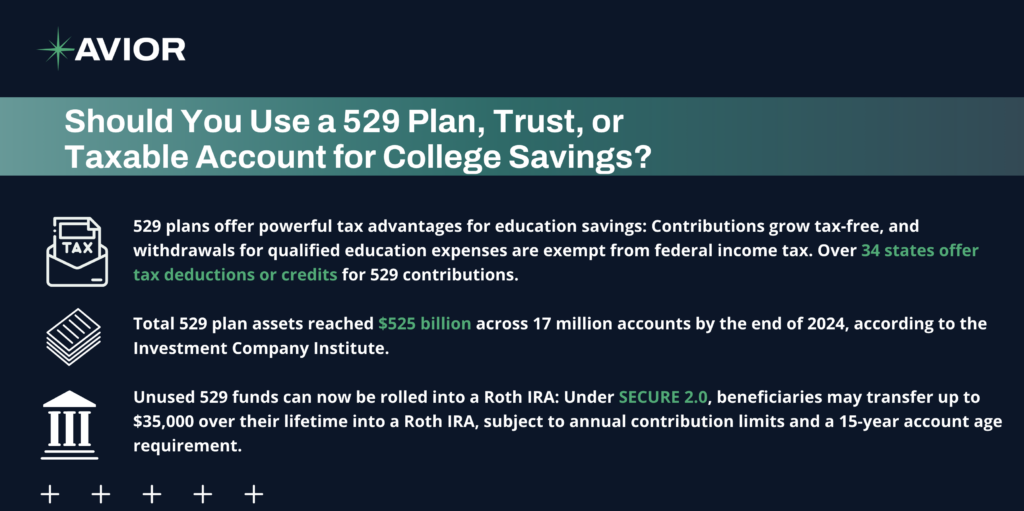
- 529 plans offer powerful tax advantages for education savings: Contributions grow tax-free, and withdrawals for qualified education expenses are exempt from federal income tax. Over 34 states offer tax deductions or credits for 529 contributions.
- Total 529 plan assets reached $525 billion across 17 million accounts by the end of 2024, according to the Investment Company Institute.
- Unused 529 funds can now be rolled into a Roth IRA: Under SECURE 2.0, beneficiaries may transfer up to $35,000 over their lifetime into a Roth IRA, subject to annual contribution limits and a 15-year account age requirement.
- Trusts provide more control over how and when funds are used, which may be valuable for families with larger estates, blended family dynamics, or beneficiaries who might need guardrails around spending.
- Taxable accounts offer maximum flexibility with no restrictions on how the money is spent, though they lack the tax-sheltered growth that 529s and certain trusts provide.
The 529 Plan: Tax Efficiency Built for Education
The 529 plan is the default recommendation for most families saving for college, and the tax math explains why. Contributions grow on a tax-deferred basis, and withdrawals used for qualified education expenses, including tuition, room and board, books, and even up to $10,000 per year for K-12 tuition, come out entirely free of federal income tax. Many states sweeten the deal with a state income tax deduction or credit for contributions.
Where the 529 Shines
The compounding effect of tax-free growth over 15 or 18 years can be substantial. A family that invests $300 per month starting at a child’s birth could accumulate a meaningful balance by the time college arrives, especially in a diversified age-based portfolio that adjusts its allocation as the enrollment date gets closer. Research suggests that families who began saving in a 529 when their child was five or younger had 71% more saved than those who waited until age 11 or later. That early start, combined with tax-free compounding, is the 529’s strongest selling point.
The SECURE 2.0 Act also added an important safety valve. Starting in 2024, beneficiaries of 529 accounts that have been open for at least 15 years may roll unused funds into a Roth IRA, up to a $35,000 lifetime maximum and subject to annual Roth IRA contribution limits. This change eases one of the biggest hesitations families have had about 529s: the fear of overfunding an account and facing a 10% penalty on nonqualified withdrawals.
Where the 529 Falls Short
For all its tax benefits, the 529 has real limitations. Withdrawals used for anything other than qualified education expenses are subject to income tax and a 10% federal penalty on the earnings portion. Investment choices are limited to whatever the plan offers, and you can only change your investment selection twice per calendar year. There are also financial aid implications worth considering. While 529 plans owned by a parent are treated relatively favorably under the FAFSA formula, distributions from grandparent-owned 529s could, depending on timing, affect a student’s financial aid eligibility. And if your child receives a full scholarship, pursues a trade instead of college, or simply doesn’t need the full balance, you’re left with fewer options than a more flexible account would provide.
Trusts: Control and Customization for Complex Situations

For families with larger estates or more complicated dynamics, a trust can offer something a 529 cannot: precise control over how, when, and under what conditions the money gets used. Trusts come in many forms, but the ones most commonly used for education funding include revocable living trusts, irrevocable trusts, and custodial accounts under the Uniform Transfers to Minors Act (UTMA).
When a Trust Makes Sense
A trust might be the right tool if you want to impose conditions on access, such as requiring the beneficiary to maintain a certain GPA, use funds only for specific types of institutions, or limit distributions to education-related expenses until a certain age. Trusts also allow you to name a trustee who manages the assets and makes distribution decisions, which can provide a layer of protection if the beneficiary is young, financially inexperienced, or has special needs.
For families concerned about estate planning, an irrevocable trust funded with education assets may help remove those assets from the grantor’s taxable estate. With the federal estate tax exemption at $15 million per individual in 2026, this benefit applies primarily to higher-net-worth families, but for those it does affect, the planning implications can be significant.
The Trade-Offs
Trusts are more expensive to establish and maintain than a 529. Attorney fees for drafting the trust document, ongoing trustee fees, and the annual tax return requirement all add cost and complexity. Trust income is also taxed at compressed rates, meaning it reaches the highest federal income tax bracket at a much lower threshold than individual income. In 2026, trust income above roughly $14,450 could be taxed at 37%. Unless the trust makes distributions to the beneficiary, which shifts the tax burden to the beneficiary’s (likely lower) rate, the tax inefficiency can erode returns over time.
Taxable Brokerage Accounts: Flexibility With No Strings
A standard brokerage account lacks the tax advantages of a 529 and the structural control of a trust. What it offers instead is complete flexibility. There are no contribution limits, no restrictions on how the money can be used, no penalties for nonqualified withdrawals, and no impact on your investment choices.
Why Some Families Prefer Taxable Accounts
If you’re uncertain whether your child will attend college, or if you want the option to redirect the savings toward a first home, a gap year, starting a business, or any other purpose, a taxable account keeps all doors open. You maintain full ownership and control at all times. The money is simply yours, invested however you choose, and available whenever you need it.
Taxable accounts also avoid the financial aid complications that can arise with certain education-specific accounts. And for families already maximizing their 529 contributions, a taxable account is a natural supplement to continue building college savings beyond the 529’s practical limits.
The Tax Reality
The downside is straightforward is that you pay taxes on dividends, interest, and capital gains as they’re realized. Long-term capital gains rates are more favorable than ordinary income rates, and thoughtful tax-loss harvesting can help manage the tax drag over time. But compared to the tax-free growth inside a 529, the after-tax returns in a taxable account will typically be lower over the same time horizon. For families in higher tax brackets, that difference could be meaningful over 18 years of compounding.
How to Decide: Matching the Account to Your Situation
There is no universal answer, but a few guiding principles could help clarify which approach makes sense for your family.
If Education Is the Clear Priority
For families who are confident the funds will be used for college or graduate school, the 529 is likely the most tax-efficient option. The tax-free growth and the new Roth IRA rollover provision under SECURE 2.0 reduce the risk of overfunding. Starting early maximizes the compounding benefit, and most state-sponsored plans offer low-cost, diversified portfolio options.
If You Need More Control
Families with blended family situations, concerns about a beneficiary’s spending habits, or significant estate planning goals may find a trust more appropriate. The added cost and complexity could be worthwhile if the alternative is handing a young adult unrestricted access to a large sum. A trust also allows for multi-generational planning that a 529 cannot easily accommodate.
If Flexibility Is More Important
When the future is genuinely uncertain, whether about the child’s educational path, the family’s financial trajectory, or potential changes in tax law, a taxable account provides the widest range of options. It sacrifices tax efficiency for freedom, which could be the right trade-off depending on your circumstances.
If You Can Afford to Combine Approaches
Many families find that a blended strategy works best. A hypothetical example: a couple might contribute to a 529 up to their state’s tax deduction limit each year, fund a custodial trust for their child with an annual gift that stays within the $19,000 gift tax exclusion, and invest additional savings in a joint taxable account earmarked for education but available for other goals if plans change. Each account serves a different purpose, and together they create a more resilient funding strategy.
Work With Us
Choosing where to save for college is a financial planning decision that affects your tax strategy, your estate plan, and your family’s long-term flexibility. A 529 plan provides unmatched tax efficiency for education-specific savings, a trust offers structural control for complex family situations, and a taxable account preserves optionality when the path forward is still taking shape. The right combination depends on your income, your goals, and how much certainty you have about how the funds will ultimately be used.
At Avior, we help families build college savings strategies that fit within a broader financial plan. Whether you’re weighing the merits of a 529 against a trust, exploring how SECURE 2.0 changes the calculation, or looking for a coordinated approach that covers multiple goals at once, our team can help you think through the trade-offs and build a plan that works. Get in touch to start the conversation.



No Comments
Sorry, the comment form is closed at this time.