


Can You Afford to Retire This Year? A January Self-Assessment Guide
January arrives with fresh calendars and new possibilities. For people approaching traditional retirement age, this moment often triggers a deeper question that extends beyond typical New Year’s resolutions: Can I actually afford to retire this year? The question carries weight because answering it incorrectly means either working longer than necessary or retiring into financial stress that could have been avoided with better planning.
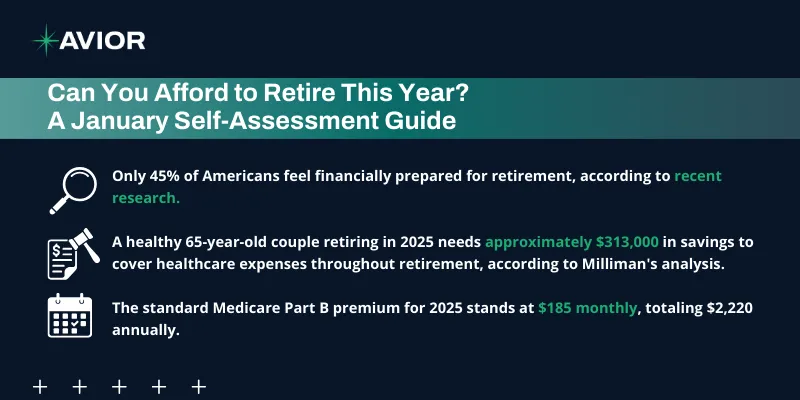
Only 45% of Americans feel financially prepared for retirement, according to recent research. This widespread uncertainty stems from the complexity of retirement planning itself, weighing Social Security timing, healthcare costs, investment volatility, and spending needs against savings that must potentially last three decades or more. January offers a natural checkpoint for honest assessment. Taking time now to evaluate your retirement readiness positions you to make informed decisions about your timeline rather than relying on guesswork or outdated assumptions about what constitutes sufficient preparation.
Calculate Your True Retirement Budget
Understanding how much money you’ll actually spend in retirement forms the foundation of any affordability assessment. Many people assume they’ll need 70-80% of their pre-retirement income, yet this rough estimate fails to account for individual circumstances that dramatically affect spending patterns.
Start by categorizing your current expenses into categories that will likely increase, decrease, or disappear entirely in retirement. Housing costs might drop if you’ve paid off your mortgage, while healthcare expenses typically rise. Commuting costs vanish, but travel spending often increases for newly retired individuals who finally have time to explore. Work-related expenses like professional wardrobes and daily lunches disappear, while hobbies and leisure activities expand.
Build a detailed monthly budget that reflects your anticipated retirement lifestyle. Include property taxes, insurance premiums, utilities, food, transportation, entertainment, and a buffer for unexpected expenses. Many retirees find their spending decreases over time as they age and travel less, but starting with realistic numbers for your early retirement years prevents unpleasant surprises.
Assess Healthcare Cost Projections
Healthcare represents one of the largest and most unpredictable retirement expenses. A healthy 65-year-old couple retiring in 2025 needs approximately $313,000 in savings to cover healthcare expenses throughout retirement, according to Milliman’s analysis. This figure assumes enrollment in Medicare with supplemental coverage, highlighting why healthcare planning deserves serious attention.
Medicare eligibility begins at 65, creating a critical consideration for anyone planning to retire before reaching that age. Private health insurance for a couple in their early 60s can easily cost $1,500-$2,500 monthly, adding $18,000-$30,000 annually to your budget until Medicare kicks in. These costs demand specific planning rather than vague assumptions about managing somehow.
Even after Medicare enrollment, expenses continue. The standard Medicare Part B premium for 2025 stands at $185 monthly, totaling $2,220 annually. Higher-income retirees pay surcharges based on their modified adjusted gross income from two years prior, potentially pushing premiums significantly higher. Add Medicare Part D prescription coverage, Medigap policies or Medicare Advantage plans, and out-of-pocket costs for services Medicare doesn’t fully cover, and healthcare easily consumes a substantial portion of retirement income.
Evaluate Your Income Sources
Retirement income typically flows from multiple sources rather than a single stream. Social Security provides the foundation for most retirees, with 72% of Americans expecting to rely on these benefits during retirement. Your claiming age dramatically affects monthly benefit amounts, filing at 62 results in permanently reduced payments compared to waiting until full retirement age of 67, while delaying until 70 maximizes lifetime benefits for those who can afford to wait.
Calculate your expected Social Security benefit using your online Social Security account, which shows estimates at various claiming ages. Consider how this timing decision intersects with your other income sources and overall retirement plan. Someone with substantial retirement savings might benefit from delaying Social Security and drawing from investments early, while others need the income immediately upon retirement.
Beyond Social Security, inventory all other income streams. Pension benefits, if you’re fortunate enough to have one, provide guaranteed monthly income. Rental property generates ongoing cash flow. Part-time work or consulting arrangements supplement retirement savings. Annuities purchased specifically for retirement income create additional guaranteed payments. Understanding the total monthly income available from all sources helps you determine how much you’ll need to withdraw from investment accounts to meet your budget.
Apply Withdrawal Rate Guidelines
The amount you can safely withdraw from retirement accounts each year determines whether your savings will sustain your lifestyle throughout retirement. Traditional guidance suggested a 4% initial withdrawal rate, adjusted annually for inflation, would sustain a portfolio for 30 years. Recent research suggests more nuanced approaches based on current market conditions and individual circumstances.
Recent research recommends a 3.7% safe starting withdrawal rate for people just embarking on retirement, reflecting conservative assumptions about future market returns. Meanwhile,Bengen, who introduced the 4% rule, recently updated his famous rule to 4.7%, arguing that broader portfolio diversification and improved research support higher sustainable withdrawals. The gap between these recommendations illustrates how personal factors, risk tolerance, other income sources, spending flexibility, affect appropriate withdrawal rates.
Apply these percentages to your actual savings to see whether the resulting income meets your needs. Someone with hypothetical $1 million in retirement accounts withdrawing 4% annually generates $40,000 in the first year, while a 3.7% rate produces $37,000. If your budget requires $60,000 annually and Social Security provides $30,000, you need retirement accounts that can supply the $30,000 gap. Working backward, that suggests roughly $750,000-$810,000 in savings depending on which withdrawal rate you use.
Review Your Investment Allocation
Portfolio composition affects both growth potential and withdrawal sustainability. Retirement accounts heavily weighted toward bonds offer stability but limited growth potential that may struggle to keep pace with inflation over multi-decade retirements. Portfolios dominated by stocks provide greater growth potential but expose retirees to market volatility that could devastate savings if a major downturn strikes early in retirement.
Classic safe-withdrawal research (e.g., the 4% rule literature) commonly evaluates balanced stock/bond allocations, often around 50/50 to 60/40, and finds that these mixes have historically supported withdrawal rates in the neighborhood of 4% over 30-year retirementsYounger retirees with longer time horizons might maintain higher stock allocations, while older retirees often reduce equity exposure as their spending horizon shortens. Your allocation should reflect your specific timeline, risk tolerance, and overall financial situation rather than following generic age-based formulas.
Examine your current investment mix across all retirement accounts. Calculate the percentage allocated to stocks, bonds, and cash. Consider whether this allocation aligns with your retirement timeline and risk tolerance. Someone planning to retire this year with 90% of their portfolio in stocks faces considerable sequence-of-returns risk if markets decline early in retirement, while someone with 90% in bonds may lack growth needed to sustain purchasing power through inflation.
Consider Tax Implications
Retirement income faces varying tax treatment depending on its source, and these differences affect your net spendable income. Distributions from traditional IRAs and 401(k)s count as ordinary income subject to federal and state income taxes. Roth account withdrawals arrive tax-free. Social Security benefits face taxation based on your combined income, with 0%, 50%, or 85% of benefits potentially taxable depending on your total income level.
Calculate your projected tax liability in retirement. If most retirement savings sit in traditional tax-deferred accounts, every dollar withdrawn triggers income taxes.
Tax diversification across account types, maintaining balances in traditional IRAs, Roth accounts, and taxable brokerage accounts, provides flexibility to manage tax liability in retirement. Drawing from different account types strategically helps control taxable income year to year, potentially reducing Medicare surcharges and Social Security benefit taxation.
Factor in Inflation Protection
Purchasing power erosion poses a serious threat to retirement security. Inflation averaging just 3% annually cuts your money’s buying power in half over roughly 24 years. The hypothetical $10,000 monthly budget that seems adequate today will feel increasingly tight as prices rise throughout retirement unless your income keeps pace.
Social Security benefits include annual cost-of-living adjustments designed to maintain purchasing power, though these adjustments sometimes lag actual inflation in specific expense categories like healthcare. Investment portfolios need sufficient growth orientation to outpace inflation over time. Fixed income sources like traditional pensions or immediate annuities purchased today will buy less each passing year unless they include inflation protection features.
Review how your retirement income plan addresses inflation. Portfolios maintaining reasonable stock allocations typically generate long-term returns exceeding inflation. Treasury Inflation-Protected Securities (TIPS) provide explicit inflation protection. Delaying Social Security increases both your base benefit and future cost-of-living adjustments. Building explicit inflation assumptions into your retirement projections, typically 2-3% annually, helps ensure your plan remains viable as prices increase.
Test Different Retirement Dates
Retiring this year versus waiting one, two, or three more years creates dramatically different financial outcomes. Each additional working year provides multiple benefits: continued salary and benefits, additional retirement contributions, more time for existing investments to grow, delayed withdrawals from retirement accounts, and potentially higher Social Security benefits if you haven’t yet reached age 70.
Model various retirement dates to quantify the differences. Consider partial retirement scenarios as well. Transitioning to part-time work or consulting arrangements allows you to leave full-time employment while maintaining some income and possibly health insurance benefits. This hybrid approach can bridge the gap to Medicare eligibility at 65 or Social Security optimization at 70 while reducing the withdrawals needed from retirement savings.
Work With Us
Determining whether you can afford to retire this year requires an honest assessment of your complete financial picture, projected expenses including healthcare costs, income from all sources, sustainable withdrawal rates from investments, portfolio allocation appropriateness, tax implications, and inflation protection. January provides an ideal moment for this evaluation, giving you the entire year to make informed decisions about your retirement timeline rather than relying on assumptions or outdated rules of thumb.
At Avior, we help clients navigate the complexities of retirement readiness through comprehensive planning that examines all aspects of your financial situation. Our approach goes beyond simple withdrawal rate calculations to develop personalized strategies addressing healthcare planning, tax efficiency, Social Security optimization, and investment management aligned with your specific retirement goals and timeline. Schedule a consultation with our team to receive a thorough retirement readiness assessment and discover whether this year represents the right time for your transition into retirement.



No Comments
Sorry, the comment form is closed at this time.