


How Strategic Giving Can Offset Capital Gains Before Year-End
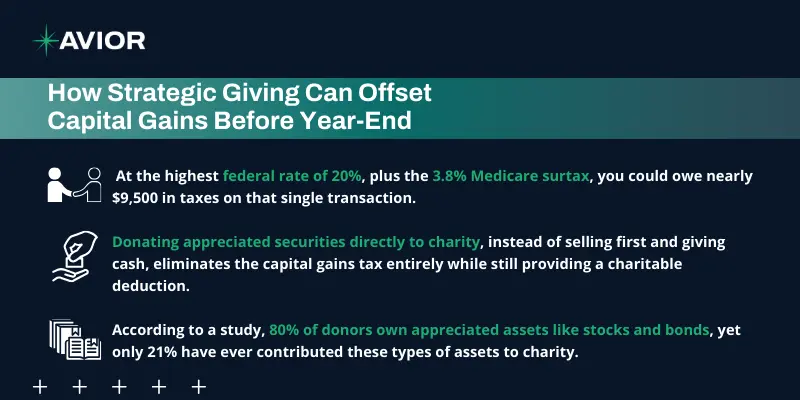
Selling investments that have grown in value feels like a win—until tax season arrives. Imagine a stock you bought at $10,000 and sold for $50,000. Now, the IRS wants a piece of your $40,000 gain. At the highest federal rate of 20%, plus the 3.8% Medicare surtax, you could owe nearly $9,500 in taxes on that single transaction. State taxes might add even more.
But the same appreciated assets that create tax headaches can become powerful charitable tools if you handle them correctly. Donating appreciated securities directly to charity, instead of selling first and giving cash, eliminates the capital gains tax entirely while still providing a charitable deduction. According to a study, 80% of donors own appreciated assets like stocks and bonds, yet only 21% have ever contributed these types of assets to charity. That disconnect represents billions in missed tax savings and reduced charitable impact every year. With year-end approaching, now is the time to understand how strategic giving can transform your tax picture.
Why Donating Stock Beats Donating Cash
When you sell appreciated stock, pay taxes on the gain, and donate the remaining cash, you lose twice. First, you pay capital gains tax that reduces what you have available to give. Second, your charitable deduction only covers the after-tax amount you actually donated. The math works against you.
Direct donation of appreciated stock flips this equation. The charity receives the full value of the shares. You receive a deduction for the full fair market value. Nobody pays capital gains tax because qualified charities are tax-exempt entities. The result: more money goes to causes you care about, and you keep more of your wealth.
A Simple Comparison
Imagine you hold stock worth $50,000 that you purchased years ago for $10,000. If you sell and donate the cash, you’d pay roughly $9,500 in federal capital gains taxes (at the combined 23.8% rate), leaving $40,500 for charity. Your deduction covers $40,500.
If instead you donate the stock directly, the charity receives the full $50,000. Your deduction covers $50,000. You’ve increased your gift by nearly $10,000 and boosted your tax savings proportionally—all by changing the order of operations.
The One-Year Holding Rule
This strategy only works with assets you’ve held longer than one year. Short-term holdings (owned for a year or less) don’t qualify for the full fair market value deduction. If you donate short-term appreciated stock, your deduction is limited to your original cost basis, not the current value. The charity still gets the full value, but you miss out on the enhanced tax benefit.
Review your portfolio now to identify positions with both significant appreciation and holding periods exceeding 12 months. These are your prime candidates for year-end charitable giving. The longer you’ve held an asset and the more it has appreciated, the greater the tax advantage of donating it directly.
Donor-Advised Funds Simplify Everything
Most charities prefer cash. They have staff, programs, and bills to pay. Accepting stock donations requires extra administrative work that smaller organizations may struggle to handle. This creates friction that discourages donors from using their appreciated assets.
Donor-advised funds (DAFs) solve this problem. A DAF acts as a charitable middleman. You donate your appreciated stock to the fund, receive your tax deduction immediately, and the fund sells the shares without capital gains consequences. The cash sits in your account, growing tax-free, until you recommend grants to specific charities over time. The charities get cash, you get the tax benefits of donating stock, and the process stays simple.
The Bunching Strategy
The standard deduction for 2025 sits at $31,500 for married couples filing jointly. If your itemized deductions don’t exceed that threshold, you get no additional tax benefit from charitable contributions. Many generous donors find themselves in this frustrating position—giving regularly but never itemizing.
Bunching solves this by concentrating multiple years of giving into a single tax year. You itemize in year one, then take the standard deduction in subsequent years while still recommending grants from your DAF to support charities. Over the five-year period, your total tax savings increase substantially.
Real Estate and Other Appreciated Assets
Stock isn’t your only option. Real estate, closely held business interests, cryptocurrency, and other appreciated property can all be donated directly to charity with similar tax benefits. The rules get more complex, you’ll need qualified appraisals for non-publicly traded assets, but the principle remains the same: donating appreciated property directly eliminates capital gains while generating deductions.
Real estate donations work particularly well when you own property you no longer want to manage but would face substantial taxes upon sale. A vacation home purchased decades ago, investment land that has appreciated, or rental property you’ve depreciated all carry embedded tax liabilities that charitable donation can eliminate.
Timing Matters for Year-End
Stock donations are recorded on the transfer initiation date, not when the charity or fund receives the shares. If you want the deduction to count for 2025, start the transfer process now. Brokerage transfers can take days or even weeks to complete. Waiting until late December risks missing the deadline entirely.
Contact your financial advisor or brokerage firm to understand their specific timeline for charitable stock transfers. Many recommend initiating donations by mid-December to ensure completion before year-end.
Deduction Limits to Know
Charitable deductions for donated appreciated property are capped at 30% of your adjusted gross income (AGI). Cash donations to public charities allow up to 60% of AGI. If your donation exceeds these limits, you can carry forward the excess deduction for up to five additional years.
This limit matters for planning purposes. If you’re considering a large donation of appreciated assets, calculate whether it will exceed 30% of your AGI. If so, you might split the donation across two tax years or combine it with cash gifts to maximize current-year benefits while carrying forward the remainder.
The Qualified Charitable Distribution Alternative
For donors over 70½ with traditional IRAs, qualified charitable distributions (QCDs) offer another powerful tool. A QCD lets you transfer up to $108,000 directly from your IRA to charity in 2025. The distribution counts toward your required minimum distribution if applicable, but it never hits your taxable income. Unlike regular deductions, QCDs aren’t affected by the new limitations taking effect in 2026.
QCDs work best for retirees who don’t need their full RMD for living expenses. The transfer reduces your adjusted gross income, which can lower Medicare premiums, reduce Social Security taxation, and provide other benefits beyond the direct tax savings.
Acting Before Rules Change
Tax law changes arriving in 2026 will reduce the value of charitable deductions for many high-income donors. A new 0.5% AGI floor means your first donations of the year won’t generate any deduction at all. A 35% cap on deduction value (down from 37%) further compresses the benefit for top-bracket taxpayers.
These changes make 2025 an unusually valuable year for charitable giving. Accelerating planned donations into this year—whether through direct stock gifts, DAF contributions, or other vehicles—locks in the current, more favorable rules. Donors who wait may see meaningful reductions in their tax savings for identical contributions.
Work With Us
Strategic charitable giving transforms what could be a significant tax liability into meaningful support for causes you care about while preserving more of your wealth. Donating appreciated stock directly, using donor-advised funds, bunching contributions, and timing your gifts around year-end deadlines all amplify the impact of your generosity. With tax rule changes on the horizon, the window for maximizing these benefits is narrowing. The moves you make before December 31st will determine whether you capture the full advantage or leave money on the table.
At Avior, we help clients integrate charitable giving into comprehensive financial plans that address investment management, tax efficiency, and philanthropic goals together. We can identify appreciated positions in your portfolio, calculate the tax impact of different giving strategies, and coordinate with your tax advisor to ensure you’re maximizing benefits before year-end. If you’re considering charitable contributions and want to make sure you’re using the most tax-efficient approach, schedule a consultation with our team. Let’s turn your generosity into smarter financial planning.



No Comments
Sorry, the comment form is closed at this time.