


How to Decide if It’s Time to Upgrade Your Policy
The life insurance policy you bought five years ago made perfect sense at the time. You were single, renting an apartment, and your biggest financial obligation was probably a car payment. Fast forward to today, and you’re married with two kids, a mortgage, and aging parents who might need help down the road. That original policy? It might be outdated now.
Upgrading your life insurance feels like one of those tasks that’s easy to put off. After all, you already have coverage, which puts you ahead of the nearly half of Americans who have no life insurance at all. Still, having coverage and having adequate coverage are two different things. Your policy should grow and adapt as your life changes, because what protected you in your twenties won’t necessarily shield your family in your forties. The question becomes: how do you know when it’s actually time to make a change?
Major Life Changes Signal It’s Time to Review
Marriage changes everything about your financial picture. You’re combining incomes, sharing expenses, and building a life together that requires protection beyond what either of you planned for individually. A policy designed to cover your solo life won’t stretch far enough to support a spouse who’s counting on your income to maintain their standard of living.
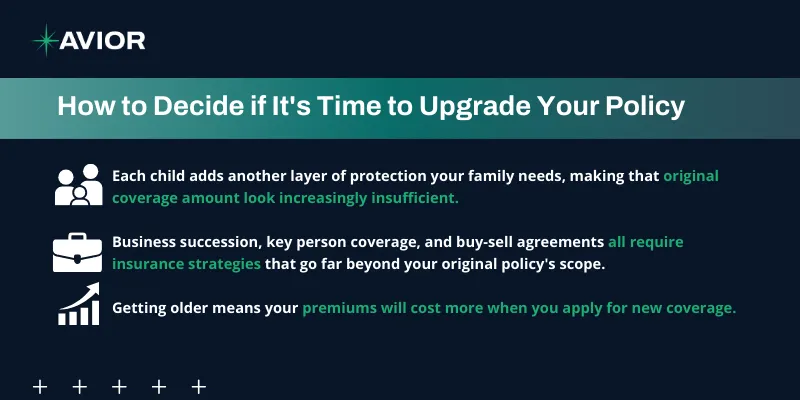
Children multiply your financial responsibilities overnight. Beyond the obvious costs of raising kids, you’re thinking about college funds, childcare expenses, and the years your spouse might step back from work to stay home. Each child adds another layer of protection your family needs, making that original coverage amount look increasingly insufficient.
Your Career Growth Demands More Protection
A promotion might come with a bigger paycheck, but it also means your family has grown accustomed to that higher income level. They’re counting on it for mortgage payments, school tuition, and the lifestyle you’ve built together. Your current policy might replace your old salary just fine, but can it replace what you’re earning now? Probably worth checking.
Business ownership creates an entirely different set of concerns. Partners depend on you, employees rely on the company’s stability, and your family’s wealth is tied up in an enterprise that could crumble without proper planning. Business succession, key person coverage, and buy-sell agreements all require insurance strategies that go far beyond your original policy’s scope.
The House Changed Everything
Buying a home typically means taking on the largest debt of your life. Your mortgage lender requires enough coverage to pay off the loan if something happens to you, but your original policy predates this massive obligation. Add in home equity loans, renovation costs, or that investment property you picked up, and the gap between your coverage and your actual needs keeps widening.
Paying off your mortgage creates the opposite problem. You might be carrying more coverage than your family actually needs now, which means you’re spending money on premiums that could work harder for you elsewhere. Some people forget to reassess when debt disappears, leaving protection in place that no longer serves its original purpose.
Health Changes Create Urgency
Getting older means your premiums will cost more when you apply for new coverage. Medical conditions that develop over time can make qualifying for additional insurance difficult or even impossible. If you’re healthy now but anticipate needing more coverage, acting sooner rather than later can save you thousands over the life of a new policy.
Term policies come with expiration dates. As your term approaches its end, you’ll face a choice: renew at rates that reflect your current age, convert to a permanent policy, or shop for entirely new coverage. Each option has trade-offs, but doing nothing means your coverage simply disappears when you might still need it desperately.
Your Existing Coverage Might Fall Short
Group life insurance through work typically covers one to two times your annual salary. That sounds generous until you run the numbers on what your family would actually need to replace your income, pay off debts, fund college, and maintain their lifestyle. Employer coverage also disappears when you leave your job, creating a coverage gap at precisely the wrong moment.
Inflation quietly erodes the purchasing power of your death benefit. The $250,000 policy you bought a decade ago won’t cover the same expenses today. College costs have climbed, healthcare expenses have multiplied, and the cost of maintaining your family’s lifestyle has grown along with everything else. Your coverage amount should account for these realities.
Financial Advisors Can Clarify Your Needs
Professional guidance takes the guesswork out of determining adequate coverage. A detailed needs analysis examines your debts, income replacement requirements, future obligations, and existing assets to calculate a precise coverage amount. This removes the emotional component from decision-making and grounds your choices in actual numbers.
Policy reviews should happen regularly, ideally every few years or whenever major life events occur. Financial advisors can spot coverage gaps you might miss, recommend riders that add valuable protection, and help you compare options across different carriers to find the best value for your situation.
Work With Us
Deciding to upgrade your life insurance policy stems from recognizing that your life has evolved beyond your original coverage. Marriage, children, career advancement, homeownership, and health changes all create legitimate reasons to reassess what protection your family actually needs. The policy that made sense years ago might leave dangerous gaps in your current situation, while some people carry more coverage than circumstances warrant.
At Avior, we specialize in helping clients align their insurance strategies with their complete financial picture. Our comprehensive approach examines your current coverage, identifies gaps or excesses, and develops solutions that protect your family without wasting money on unnecessary premiums. We work with you to build an insurance strategy that adapts as your life changes, giving you confidence that the people you love will have the resources they need. Schedule a consultation with our team to review your current coverage and discover whether it’s time to make a change that better serves your family’s future.
Investment management and financial planning services are offered through Avior Wealth Management, LLC, an SEC-registered investment adviser. Tax and accounting services are provided by Avior Tax and Accounting, LLC, a wholly-owned subsidiary of Avior Wealth Management, LLC.
Insurance products, including life, disability, long-term care, and annuities, are offered through Avior Insurance. Insurance and annuity products are not offered through Avior Wealth Management, LLC, and are not covered by SIPC. Avior Insurance operates independently to provide insurance solutions tailored to clients’ needs. Insurance products are subject to the terms and conditions of the issuing carrier.
All information contained herein is general in nature and is not to be construed as specific investment advice. Avior does not provide legal advice. Clients should consult their own legal, tax, and financial professionals before making any decisions. All investments involve risk, including the potential loss of principal. Past performance is not indicative of future results.



No Comments
Sorry, the comment form is closed at this time.