


Tax Meeting Checklist: Documents Your Tax Pro Needs (Plus Questions to Ask)
Tax preparation meetings arrive annually with the same predictability as the April 15 deadline, yet many people still show up unprepared, missing critical documents that force multiple follow-up visits and delayed filings. Walking into your tax professional’s office without proper documentation wastes everyone’s time while potentially costing you money through missed deductions or rushed preparation that overlooks tax-saving opportunities.
Your tax preparer needs specific information to file an accurate return that captures all available deductions and credits while meeting IRS requirements. Gathering these documents before your appointment streamlines the process, reduces back-and-forth communication, and gives your tax professional adequate time to identify strategies that minimize your tax liability. Taking an organized approach to your tax meeting transforms what could be a stressful scramble into a productive planning session that positions you for better tax outcomes both this year and in years ahead.
Key Takeaways
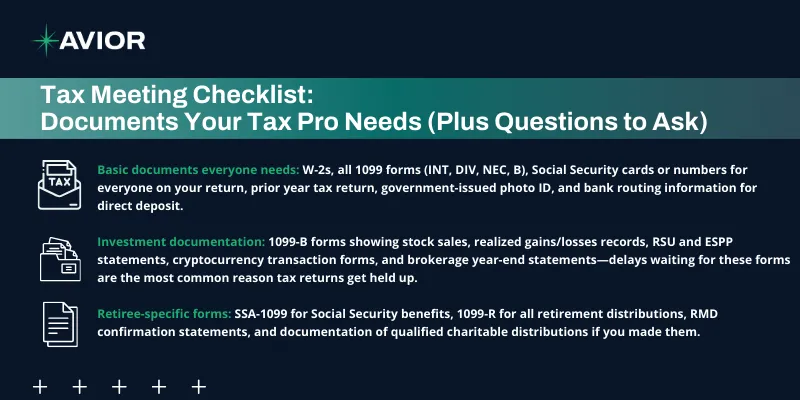
- Basic documents everyone needs: W-2s, all 1099 forms (INT, DIV, NEC, B), Social Security cards or numbers for everyone on your return, prior year tax return, government-issued photo ID, and bank routing information for direct deposit.
- Investment documentation: 1099-B forms showing stock sales, realized gains/losses records, RSU and ESPP statements, cryptocurrency transaction forms, and brokerage year-end statements—delays waiting for these forms are the most common reason tax returns get held up.
- Retiree-specific forms: SSA-1099 for Social Security benefits, 1099-R for all retirement distributions, RMD confirmation statements, and documentation of qualified charitable distributions if you made them.
- Homeowner deduction records: Form 1098 for mortgage interest, property tax statements, refinance closing documents if applicable, and receipts with product information for energy-efficient home improvements.
- Deduction documentation: Charitable contribution receipts (written acknowledgment required for donations over $250), medical expense receipts (deductible when exceeding 7.5% of AGI), childcare provider information including their tax ID, and estimated tax payment records.
- Strategic questions to ask: How major financial decisions (home purchases, retirement distributions, investment sales) will affect your taxes, what estimated payments you’ll need for next year, and which deductions you might be missing.
The Master Checklist: Documents Every Taxpayer Needs
Certain documents apply to nearly everyone who files taxes, regardless of employment status or financial complexity.
Personal Identification
Social Security cards or numbers for yourself, your spouse, and all dependents form the foundation of your tax return. A single incorrect digit triggers IRS rejection, delaying refunds and creating unnecessary complications. Bring government-issued photo identification like a driver’s license or passport, especially for first-time meetings with a new tax preparer. Birth dates for all family members appearing on your return help verify dependency claims and determine eligibility for age-based tax credits.
Income Forms
W-2 forms from all employers show wages, salary, tips, and withheld taxes. Form 1099-INT reports interest income from banks and credit unions. Form 1099-DIV documents dividend payments from investments. Form 1099-NEC shows income for self-employed individuals and contractors. Partnership and S-corporation owners receive Schedule K-1 forms detailing their share of business income and deductions.
Prior Year Return and Banking Information
Your prior year tax return provides invaluable context, showing continuing situations like capital loss carryforwards, depreciation schedules, and education credits that affect current calculations. Bank routing and account numbers enable direct deposit of refunds. The IRS now phases out paper refund checks, making this information essential for most filers.
Deduction Records
Charitable contribution receipts document your donations. Cash contributions under $250 need basic acknowledgment, while gifts over $250 require written documentation from the charity. Childcare costs require the provider’s name, address, and tax identification number. Medical expense receipts become relevant when they exceed 7.5% of your adjusted gross income. Estimated tax payment confirmations prove quarterly payments you made throughout the year.
If You Have Investments: Specialized Documentation
Investors face additional documentation requirements and should prepare specific questions for their tax professional.
Brokerage Forms and Statements
Form 1099-B details every stock, bond, or fund sale during the year. This form arrives later than most tax documents, often in mid-February or even March for complex accounts with multiple investment types. Waiting for late-arriving brokerage forms represents the most common reason tax returns get delayed. Year-end brokerage statements help verify that all 1099 forms arrived and provide account value documentation.
Cost Basis and Transaction Records
Each stock sale requires the purchase date, purchase price, sale date, and sale price to calculate capital gains or losses accurately. Your brokerage typically tracks this information, but gaps in cost basis reporting, especially for older positions or transferred accounts, require your own records. Missing or incorrect cost basis can result in overpaying taxes on sales.
Employer Stock Compensation
Restricted stock units (RSUs) and employee stock purchase plan (ESPP) transactions create complex tax reporting. RSU vesting triggers ordinary income, while ESPP sales involve both ordinary income and capital gains components. Bring all statements showing vesting dates, sale dates, grant prices, and sale prices. Your employer’s year-end summary statement helps clarify these transactions.
Cryptocurrency Documentation
Cryptocurrency transactions require Form 1099-DA from brokers or your own detailed records showing each purchase, sale, exchange, and use of digital assets. The IRS treats crypto as property, making every transaction a potential taxable event. Exchanges between different cryptocurrencies, purchases made with crypto, and crypto received as income all require documentation.
Questions to Ask About Investments
Ask your tax professional about tax-loss harvesting opportunities for next year, selling losing positions to offset gains. Understand wash sale rules that prevent you from claiming losses when you repurchase substantially identical securities within 30 days. Discuss whether Roth conversions make sense given your current tax bracket and investment timeline. Inquire about timing strategies for large stock sales or exercising stock options.
Retirees and Pre-Retirees: Retirement-Specific Documents
People receiving retirement income or approaching retirement need specialized documentation and should ask forward-looking questions.
Social Security and Retirement Distribution Forms
SSA-1099 statements document Social Security benefits received during the year. Form 1099-R shows distributions from IRAs, 401(k)s, pensions, and annuities. Bring all 1099-R forms even if you took multiple distributions throughout the year, each distribution might generate a separate form. RMD confirmation statements from your custodian prove you satisfied required minimum distribution obligations.
Withholding Elections and QCD Documentation
Documentation of federal and state tax withholding elections on retirement distributions helps your tax professional verify whether you’re having enough withheld or need to make estimated payments. If you made qualified charitable distributions (QCDs) directly from your IRA to charity, bring acknowledgement letters from the charities and your IRA custodian’s records showing the distributions. QCDs can satisfy your RMD while excluding the distribution from taxable income.
Medicare Premium Statements
Form SSA-1099 also shows Medicare Part B and Part D premiums deducted from Social Security benefits. These premiums may qualify as medical expense deductions when combined with other healthcare costs. Higher-income retirees paying Income-Related Monthly Adjustment Amounts (IRMAA) should bring documentation of these additional premium costs.
Questions About Future Tax Planning
Ask what your tax bracket will look like next year based on planned distributions and Social Security claiming strategies. Discuss whether Roth conversions make sense before RMDs begin or during lower-income years. Understand how additional income, part-time work, consulting, or larger investment gains, might push you into higher tax brackets or trigger IRMAA surcharges. Inquire about QCD strategies for future years if you’re approaching age 70½.
Homeowners: Property-Related Documentation

Homeownership creates both deduction opportunities and documentation requirements.
Mortgage Interest and Property Taxes
Form 1098 from your mortgage lender shows deductible interest paid on home loans. If you have multiple mortgages or refinanced during the year, you’ll receive multiple 1098 forms. Property tax statements from your county or municipality document payments to local governments. For tax year 2025, the total itemized deduction for state and local taxes (including property taxes) is generally capped at $40,000 for most filers.
Refinance Documentation
If you refinanced during the year, bring your closing statement. Points paid on a refinance must typically be deducted over the life of the loan rather than all at once, requiring your tax professional to calculate the annual deduction amount. Cash-out refinances might affect your mortgage interest deduction limits if the loan exceeds certain thresholds.
Energy-Efficient Improvement Credits
Energy-efficient home improvements may qualify for tax credits. Bring receipts and manufacturer certification statements for qualifying improvements, heat pumps, solar panels, energy-efficient windows and doors, insulation, and certain HVAC systems. The Inflation Reduction Act expanded these credits, but specific requirements about efficiency ratings and installation dates determine eligibility.
Home Office Documentation for Self-Employed
Self-employed individuals using part of their home for business need detailed records. Document office square footage, total home square footage, and expenses attributable to business use, mortgage interest, property taxes, utilities, insurance, repairs, and depreciation. The simplified method allows $5 per square foot up to 300 square feet without detailed expense tracking, though comparing both methods determines the better approach.
Questions About Home-Related Deductions
Ask which home improvements qualify for credits versus those that must be added to your cost basis for future sale calculations. Understand how home equity loan interest deductibility depends on how you used the borrowed funds. Discuss whether energy credits phase out at certain income levels. If you’re considering selling your home, inquire about the $250,000/$500,000 capital gains exclusion requirements.
Business Owners and Self-Employed: Additional Requirements
Self-employed individuals need comprehensive business documentation beyond what employees provide.
Business Income Records
Bring all 1099-NEC forms from clients, merchant account statements showing credit card sales, cash receipt records, and any other documentation of business revenue. Your records must match the income your clients reported to the IRS on their 1099-NEC forms.
Vehicle and Mileage Logs
Vehicle mileage logs showing business miles driven, dates, destinations, and purposes support deduction claims. Parking fees, tolls, and actual vehicle expenses require receipts when using the actual expense method. The IRS provides annual standard mileage rates, but choosing between standard mileage and actual expenses requires comparing both calculations.
Business Expense Documentation
Business equipment purchases, software subscriptions, professional development costs, advertising expenses, office supplies, and professional fees all support deduction claims when properly documented. Credit card statements and bank records help reconstruct expenses, though contemporaneous receipts provide stronger audit protection.
Healthcare Documentation Beyond Basic Insurance
Health-related tax items extend beyond standard insurance coverage.
Marketplace Coverage Forms
Form 1095-A from Health Insurance Marketplace plans documents premiums and advance premium tax credits requiring reconciliation on your return. Forms 1095-B and 1095-C from insurers and employers verify coverage meeting requirements in states with individual mandates.
Health Savings Account Records
HSA contribution limits for 2025 are $4,300 for individual coverage and $8,550 for family coverage, plus $1,000 catch-up for those 55 and older. Bring documentation of contributions from all sources, personal deposits, employer contributions, and payroll deductions, to ensure you don’t exceed limits and face penalties.
Life Changes Requiring Special Documentation
Major life events trigger tax implications requiring supporting documents.
Marital Status Changes
Marriage certificates affect filing status and create opportunities for spousal IRA contributions or credit changes. Divorce decrees specify dependency claims, support payment obligations, and property division carrying tax implications.
New Dependents
Birth certificates or adoption papers for new dependents establish dependent claims and potential credits. Death certificates for spouses or dependents trigger filing status changes. Documentation of address changes across state lines affects state tax filing requirements.
Education Expenses
Form 1098-T from educational institutions reports tuition paid and scholarships received for claiming the American Opportunity Credit or Lifetime Learning Credit. Student loan interest statements document payments supporting the up-to-$2,500 deduction for qualifying borrowers.
Strategic Questions Beyond Document Review
Transform your tax meeting from a compliance exercise into a planning session by asking forward-looking questions.
Identifying Missed Opportunities
Ask what deductions and credits you qualify for based on your circumstances. Tax professionals often identify overlooked benefits, educator expenses, jury duty pay deductions, mortgage insurance premium deductions, that clients miss. Understanding the full range of available tax breaks ensures you’re not leaving money on the table.
Planning Major Financial Decisions
Discuss how planned moves affect your taxes before executing them. Home purchases, job changes, business expansions, retirement account distributions, and investment sales all carry tax implications that advance planning can optimize. Your tax professional can recommend timing or structuring approaches minimizing tax costs.
Estimated Tax Requirements
Inquire about estimated tax payment needs for the coming year. Self-employed individuals, investors with substantial capital gains, and anyone with income lacking withholding may need quarterly estimated payments to avoid underpayment penalties. Your tax professional can calculate these amounts based on current results and anticipated income.
Future Tax Optimization
Ask how your tax situation might improve for future years. Retirement account contribution increases, charitable giving strategies, business entity structure changes, or tax loss harvesting opportunities might reduce future liabilities. Long-term tax planning often delivers more value than return preparation alone.
Work With Us
Thorough tax preparation requires gathering comprehensive documentation, identification, income statements, investment records, retirement distribution forms, homeowner documents, business expenses, and life change documentation, before meeting with your tax professional. Organized presentation of these materials enables accurate filing while helping your preparer identify opportunities to minimize tax liability through available deductions and credits. Strategic questions about planned financial moves and future tax optimization transform tax meetings from compliance exercises into valuable planning sessions that improve your financial outcomes.
At Avior, we coordinate tax planning with overall financial strategy to help clients minimize lifetime tax costs while pursuing their broader financial goals. Our integrated approach examines how investment decisions, retirement distributions, charitable giving, and business activities interact with your tax situation to identify opportunities for more efficient wealth building. Schedule a consultation with our team to discuss how comprehensive financial planning that incorporates proactive tax strategies can improve your overall financial outcomes.



No Comments
Sorry, the comment form is closed at this time.