


Planning for Retirement Without Sacrificing Lifestyle or Legacy
For affluent households, retirement planning rarely comes down to whether the money will last. It comes down to whether the life you actually want to live in retirement, and the legacy you want to leave behind, can both happen without one cannibalizing the other. That tension is often invisible during the accumulation years, but it sharpens the moment you stop working and start drawing down. Spend too freely and the inheritance shrinks. Hold back too cautiously and the years that were supposed to be the reward turn into a slow, anxious ledger-watching exercise.
The good news is that this is solvable. Households with substantial assets have planning levers that simply do not exist at lower wealth levels, and using them well lets you fund a meaningful lifestyle, transfer wealth efficiently to the next generation, and still have a buffer for the unexpected. The catch is that it takes coordination across income planning, tax strategy, estate structure, and investment policy, all at the same time. The sections below walk through what actually matters.
Key Takeaways
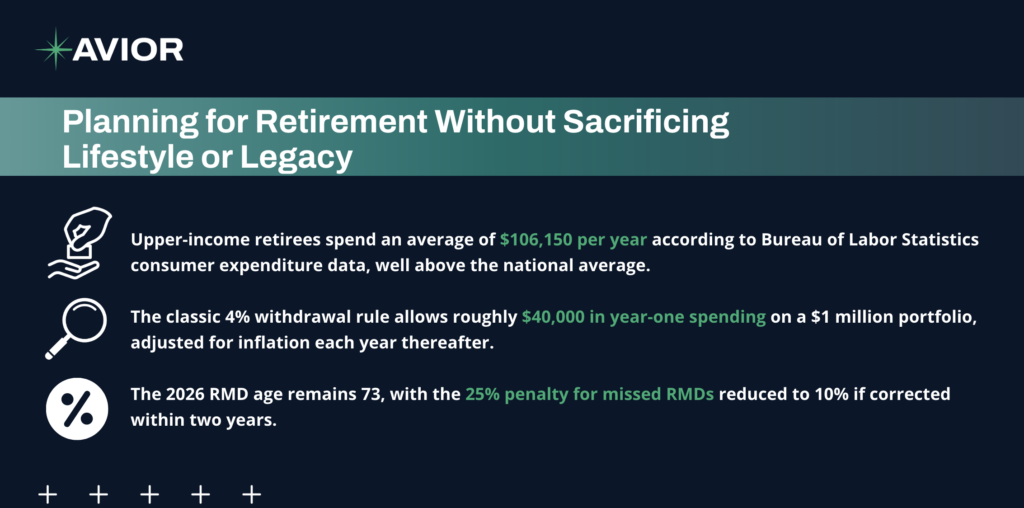
- Upper-income retirees spend an average of $106,150 per year according to Bureau of Labor Statistics consumer expenditure data, well above the national average.
- The classic 4% withdrawal rule allows roughly $40,000 in year-one spending on a $1 million portfolio, adjusted for inflation each year thereafter.
- The 2026 RMD age remains 73, with the 25% penalty for missed RMDs reduced to 10% if corrected within two years.
- The 2026 lifetime estate and gift exemption is $15 million per individual, or $30 million for married couples.
- Healthcare expenses tend to rise meaningfully with age, and 60% of retirees report spending more than expected on insurance premiums.
- High-net-worth Americans estimate they need $2.67 million to retire comfortably, per the 2026 Northwestern Mutual Planning & Progress Study.
- Delayed Social Security claims add roughly 8% per year in delayed retirement credits between full retirement age and 70.
Why the Lifestyle-vs-Legacy Tension Is Mostly a Planning Problem
The instinct to underspend in retirement is widespread, and for understandable reasons. Markets fluctuate. Healthcare costs are unpredictable. People are living longer. A retiree with $4 million might still wake up worried that one bad sequence of returns turns into a crisis at age 85. So they cut back. The legacy stays intact, but the lifestyle quietly shrinks year by year, often without the retiree fully realizing it.
The opposite happens too. A retiree who treats the portfolio as a checking account, drawing whatever feels right in any given year, may enjoy the early retirement years and then face a much harder conversation in their late seventies. Both outcomes stem from the same underlying issue: spending is decoupled from a plan that actually models the multiple competing claims on the money. With proper modeling, you may discover you can spend more than you think while still leaving everything you intend to leave behind.
How Much Can You Actually Spend Without Endangering Your Legacy?
The honest answer involves stress-testing the portfolio across many possible futures, not picking a withdrawal percentage off a chart. That said, frameworks help anchor the conversation.
The 4% Rule and Its Limits
The 4% rule, introduced by William Bengen in 1994, suggests that retirees can withdraw 4% of their portfolio in the first year of retirement and adjust for inflation each year, with high historical confidence of lasting 30 years. For a $5 million portfolio, that translates to $200,000 in year-one spending, climbing with inflation thereafter.
The rule is useful as a starting point and dangerous as a finishing one. It assumes a fairly specific stock-bond mix, a 30-year horizon, no taxes, and steady spending. For affluent households, taxes alone can change the calculus dramatically, since withdrawing from a taxable account, a traditional IRA, or a Roth produces very different after-tax cash flows from the same gross figure. Households planning for a 40-year retirement (which is increasingly common for couples retiring in their early sixties) may need to think in terms of 3% to 3.5% to be safer, while those with substantial guaranteed income from pensions or Social Security may be able to push higher.

Dynamic Withdrawal Strategies
A more sophisticated approach adjusts withdrawals based on portfolio performance. A retiree might set a base withdrawal rate of 4.5%, then cut withdrawals by some percentage in years following large market declines and increase them in years following strong returns. This approach matches the rhythm of actual market behavior better than a fixed schedule and tends to support both higher average spending and better portfolio survival rates.
The tradeoff is the variability itself. Households need to be comfortable with spending levels that move year to year, which is a different psychological proposition than a fixed inflation-adjusted draw. For many affluent retirees, the answer is a hybrid: a core spending level funded by predictable sources (Social Security, pensions, annuities, bond income) with discretionary spending tied to portfolio performance.
What Role Should Social Security and Other Guaranteed Income Play?
For affluent households, Social Security can feel like an afterthought next to the portfolio, but the claiming decision can quietly add hundreds of thousands of dollars in lifetime income.
The Case for Delaying Benefits
According to the Social Security Administration, delayed retirement credits add about 8% per year between full retirement age and 70. For a household with long life expectancy and meaningful investment assets, delaying typically produces a larger lifetime benefit, and importantly, a larger survivor benefit for the spouse who outlives the other. The increased monthly check effectively functions as longevity insurance, with the higher payments arriving exactly when other income sources may be most strained.
The right answer depends on health, family longevity, and how the gap years between retirement and benefit claiming get funded. For households with substantial taxable assets, drawing from those during the gap years (while running Roth conversions in the same window) may be more efficient than claiming early.
Building a Floor of Predictable Income
Affluent retirees often benefit from constructing what some planners call an income floor: a layer of guaranteed or near-guaranteed cash flow that covers essential expenses regardless of market conditions. This can include Social Security, pension payments, bond ladders, and in some cases annuity income. The remaining portfolio then funds discretionary spending and legacy goals with greater freedom to take risk.
The floor concept tends to reduce the emotional weight of market volatility because daily fluctuations no longer threaten the basics. That psychological cushion may translate directly into a willingness to spend on the experiences and lifestyle the retirement was supposed to fund.
How Do You Protect the Legacy While Still Living Well?
The legacy side of the equation involves estate structure, gifting strategy, and the way different account types pass to heirs.
Lifetime Gifting While You’re Alive
With the $15 million lifetime exemption per individual and a $19,000 annual exclusion per recipient, families have substantial room to transfer wealth during their lifetimes. Gifts of appreciating assets are particularly efficient, because the future growth happens outside your estate.
There is also a relational dimension. Watching children or grandchildren benefit from a gift during your lifetime tends to be more meaningful than a transfer at death. For many affluent retirees, intentional lifetime gifting (calibrated against retirement feasibility) becomes one of the more rewarding parts of the plan.
Account-Type Sequencing for Heirs
Different accounts pass to heirs with very different tax consequences. Roth IRAs flow tax-free to beneficiaries, who then have 10 years to empty inherited accounts under SECURE Act rules. Traditional IRAs flow with ordinary income tax due on every withdrawal, often hitting heirs in their peak earning years. Taxable brokerage accounts receive a step-up in basis at death, erasing the embedded capital gains.
Smart sequencing during retirement often means drawing more heavily from traditional IRAs (or converting them to Roth) and preserving Roth and highly appreciated taxable assets for the next generation. This may reduce both your own lifetime tax bill and the tax burden your heirs eventually face.
Trust Structures for Control and Protection
For families wanting more control over how inherited wealth gets used, irrevocable trusts offer a framework. Assets can be moved out of the taxable estate while distribution terms remain governed by the trust document. This often suits families with younger heirs, children with creditor concerns, or specific legacy goals around education, business succession, or charitable intent.
What Should Affluent Retirees Stress-Test in Their Plan?
Several scenarios deserve specific modeling.
Sequence of Returns Risk
A bad market in the first five to ten years of retirement is meaningfully more damaging than a bad market later, because withdrawals during a downturn lock in losses that the portfolio cannot fully recover from. Stress-testing the plan against a 1973-style or 2000-style early-retirement bear market reveals whether the spending plan can survive without permanent damage.
Longevity
Couples retiring in their early sixties may face a planning horizon of 35 years or more for at least one spouse. Plans built on a 25-year horizon may quietly run out of room in the late eighties or nineties. Modeling explicitly to age 95 or beyond provides much better confidence.
Healthcare and Long-Term Care
Long-term care costs are among the most volatile expense categories in retirement, and they tend to hit at the worst possible moment. Whether through long-term care insurance, hybrid life insurance products with LTC riders, or self-funding from a dedicated reserve, the planning conversation deserves explicit attention.
Frequently Asked Questions
Do I really need to spend less than 4% to be safe?
Depends on horizon and asset mix. Households with retirements potentially exceeding 30 years may want to start more conservatively, though guaranteed income sources can push the sustainable rate higher.
How do I balance gifting now versus inheritance later?
This is one of the higher-value conversations in financial planning. Lifetime gifts may be more efficient tax-wise and more meaningful relationally, but only if your own plan supports the capacity.
Should I keep my house in retirement?
A primary residence often serves both as housing and as a long-term care reserve. Selling and downsizing earlier may release capital for other goals, while staying allows you to age in place. Both are legitimate paths.
How often should I revisit my retirement plan?
At least annually, and more frequently if your circumstances change significantly (health, market conditions, family situation). Plans built once and forgotten tend to drift away from reality.
What if my children or heirs are not financially responsible?
This is exactly what trust structures and staged distributions are designed to address. Talking through the concern with an estate attorney often surfaces options that allow generosity without the worry.
Work With Us
Planning for retirement without sacrificing lifestyle or legacy comes down to honest modeling, deliberate income strategy, and an estate structure that reflects what you actually want for the next generation. The 4% rule and similar shortcuts are useful starting points, but affluent households gain real value from the more detailed work of stress-testing sequence-of-returns risk, optimizing Social Security timing, sequencing account drawdowns for tax efficiency, building guaranteed income floors, and coordinating lifetime gifting with retirement feasibility. When those pieces fit together, the false choice between spending now and leaving something later largely disappears.
AtAvior, we help affluent families build retirement plans that fund the life they actually want while protecting the legacy they care about. Our team integrates investment management, tax planning, Social Security strategy, estate coordination, and ongoing review into a single coherent plan, so spending decisions and gifting decisions both rest on solid ground. If you are approaching retirement or already in it and want a clearer picture of how much you can truly spend without putting your legacy at risk, we would welcome the conversation. Schedule a consultation to get started.
Investment management and financial planning services are offered through Avior Wealth
Management, LLC, an SEC-registered investment adviser. Tax and accounting services are
provided by Avior Tax and Accounting, LLC, a wholly-owned subsidiary of Avior Wealth
Management, LLC.
Insurance products, including life, disability, long-term care, and annuities, are offered through Avior Insurance. Insurance and annuity products are not offered through Avior Wealth Management, LLC, and are not covered by SIPC. Avior Insurance operates independently to provide insurance solutions tailored to clients’ needs. Insurance products are subject to the terms and conditions of the issuing carrier.
All information contained herein is general in nature and is not to be construed as specific investment advice. Avior does not provide legal advice. Clients should consult their own legal, tax, and financial professionals before making any decisions. All investments involve risk, including the potential loss of principal. Past performance is not indicative of future results.



No Comments
Sorry, the comment form is closed at this time.