


Retirement Planning After a Liquidity Event
A successful business sale, public offering, or major equity payout converts decades of effort into a sum of cash that arrives almost overnight. Personal finances change instantly. So does tax exposure, the investment timeline, and the set of decisions a founder or executive needs to make before the calendar year closes.
The window between closing day and the following April 15 carries significant weight in determining how much of the proceeds actually fund retirement. Tax treatment, reinvestment structure, and income sequencing decisions made in that period shape long-term cash flow. This piece walks through what changes after a liquidity event, which planning levers tend to matter most, and how to think about converting a one-time windfall into a durable retirement income strategy.
Key Takeaways
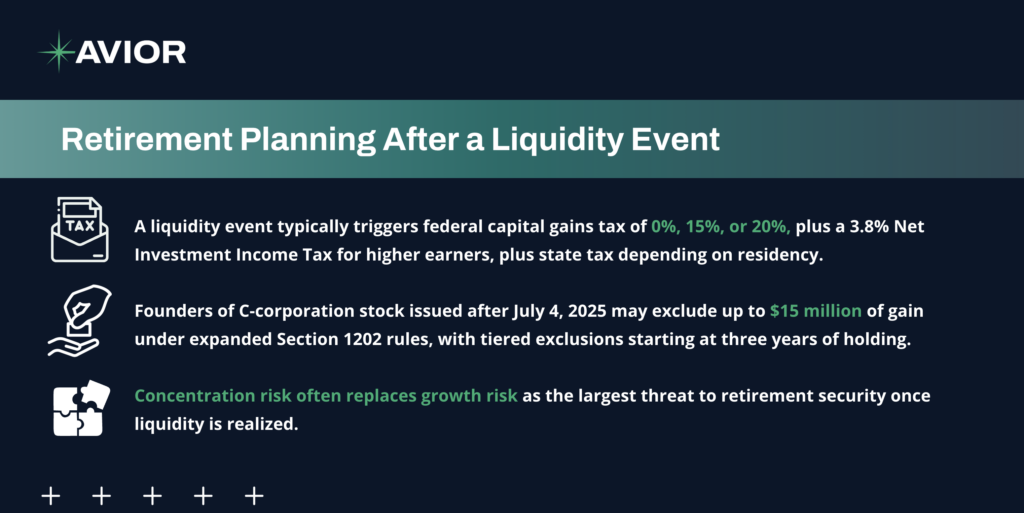
- A liquidity event typically triggers federal capital gains tax of 0%, 15%, or 20%, plus a 3.8% Net Investment Income Tax for higher earners, plus state tax depending on residency.
- Founders of C-corporation stock issued after July 4, 2025 may exclude up to $15 million of gain under expanded Section 1202 rules, with tiered exclusions starting at three years of holding.
- Concentration risk often replaces growth risk as the largest threat to retirement security once liquidity is realized.
- For 2026, the 401(k) deferral limit sits at $24,500, with workers aged 60 through 63 eligible for an enhanced catch-up of $11,250.
- Charitable remainder trusts, donor-advised funds, and installment sale structures can spread or offset taxable income over multiple years.
- Roth conversion windows often open in the years immediately following a sale, particularly if ordinary income drops sharply.
- Estate planning rises in priority once illiquid equity becomes liquid wealth that can be gifted, retitled, or placed in trust.
What changes the day the deal closes
The clearest shift is tax exposure. Long-term capital gains rates remain at 0%, 15%, or 20% depending on taxable income and filing status, but a sale large enough to fund retirement almost always lands in the 20% bracket federally. Add the 3.8% Net Investment Income Tax that applies above certain income thresholds, and the effective federal rate climbs to 23.8% before state tax enters the calculation.
State residency matters considerably here. A founder who sells while living in a high-tax state can owe a meaningfully different amount than one who established residency elsewhere in advance of the transaction. The decision is rarely simple, since many states scrutinize pre-sale moves carefully.
The second shift is portfolio construction. Equity in a private business is concentrated by definition. Cash proceeds, by contrast, can be deployed across thousands of holdings. The investment problem changes from operating risk to allocation risk, and the right answer depends heavily on the seller’s age, spending needs, and tolerance for volatility.
How much retirement income does the windfall actually support?
Sustainable withdrawal math is the most important calculation that often gets skipped in the excitement of a closing. A useful starting framework draws roughly 3.5% to 4% annually from a diversified portfolio in the first year of retirement, with adjustments for inflation each year afterward.
Consider a hypothetical example, with figures used purely for illustration. A founder sells a business for $12 million in pretax proceeds. After federal capital gains tax of roughly 20%, NIIT of 3.8%, and state tax that varies by location, after-tax proceeds may land somewhere around $8.5 million to $9.5 million. At a 3.5% withdrawal rate, that supports roughly $300,000 to $330,000 of pretax annual income, before any Social Security benefits.
That figure may sound substantial, and for many households it is. For families with significant ongoing expenses, multiple homes, or sizable philanthropic commitments, it may require careful sequencing to last across a thirty-year retirement.
Why concentration risk replaces growth risk
Before the sale, a founder’s wealth was tied to one company’s fortunes. After the sale, the threat shifts to whether the cash gets deployed appropriately. Holding everything in money market funds protects principal in nominal terms while inflation quietly erodes purchasing power. Pouring proceeds into the public equity market at a single point in time exposes the portfolio to sequence risk if the market declines in the first few years of retirement.
A measured deployment over six to eighteen months, paired with a clear asset allocation target, often makes more sense than either extreme.

Tax planning levers worth examining
Qualified Small Business Stock
For founders who held C-corporation stock that meets the Section 1202 criteria, the QSBS exclusion can shelter a substantial portion of gain from federal tax. Under the One Big Beautiful Bill Act, stock issued after July 4, 2025 qualifies for a tiered exclusion of 50% at three years, 75% at four years, and 100% at five years. The per-issuer gain cap rose to the greater of $15 million or 10 times adjusted basis. Stock issued on or before July 4, 2025 remains under the prior $10 million cap and five-year holding rule.
The eligibility rules are unforgiving and require careful documentation, so verification with tax counsel well before any sale matters significantly.
Charitable structures
Donating appreciated stock to a donor-advised fund prior to sale can produce a current-year deduction at fair market value while eliminating capital gains tax on the donated shares. Charitable remainder trusts provide an income stream to the donor over a set term while shifting the remainder to charity.
Both vehicles work better when the structure is in place before the transaction closes. Post-sale donations of cash carry less tax benefit than pre-sale donations of stock.
Installment sales and earnouts
Spreading proceeds across multiple tax years through an installment sale or structured earnout can keep marginal rates lower in any single year. The tradeoff involves counterparty risk, since deferred payments depend on the buyer’s continued ability to pay.
What about retirement accounts after the sale?
Many business owners reach a liquidity event having underfunded their tax-deferred retirement accounts compared to W-2 employees. The years immediately following a sale often present opportunities to rebuild that side of the balance sheet.
For 2026, employees may defer up to $24,500 into a 401(k) plan, with a catch-up contribution of $8,000 for those aged 50 and over. Workers aged 60 through 63 may contribute an enhanced catch-up of $11,250 under SECURE 2.0 provisions. SEP-IRA limits for self-employed individuals reach $72,000 in 2026.
Roth conversions also deserve attention. If ordinary income drops significantly in the years after a sale, converting traditional IRA balances to Roth at lower marginal rates can reduce future required minimum distributions and shift tax liability into a more favorable year.
Frequently Asked Questions
How long before a liquidity event should I start planning?
Most advisors suggest twelve to twenty-four months of lead time for the highest-leverage strategies. Pre-sale gifting, residency changes, charitable trust formation, and entity restructuring all require time to execute defensibly. Planning that starts after the term sheet is signed leaves fewer options on the table.
Will the IRS treat my sale as ordinary income or capital gain?
The treatment depends on the structure of the transaction, the nature of the assets sold, and how proceeds are allocated. Asset sales often produce a mix of ordinary income and capital gains depending on what is sold. Stock sales of qualifying C-corporation shares may receive the most favorable treatment.
Should I pay off my mortgage with sale proceeds?
This decision involves more than the interest rate comparison. Liquidity, tax deductibility of mortgage interest, and behavioral factors all matter. Many families find a partial paydown more useful than a full payoff, preserving flexibility while reducing fixed obligations.
How do I handle a sudden need for life insurance or estate planning updates?
A liquidity event often pushes a family’s net worth above the federal estate tax exemption or creates new estate planning needs that did not exist before. Updating wills, trusts, and beneficiary designations within ninety days of closing is reasonable practice. Insurance needs may also shift, particularly if the business carried key person policies that are no longer relevant.
What if I already sold without doing pre-sale planning?
Post-sale planning still offers meaningful options. Charitable contributions of cash, Roth conversion strategies, qualified opportunity zone investments, and tax-loss harvesting can reduce the total tax bill or shift it across years. The window is narrower, and it remains open.
Work With Avior
Retirement planning after a liquidity event combines tax strategy, portfolio construction, estate planning, and income sequencing into a single coordinated effort. Capital gains exposure, QSBS eligibility, charitable structures, retirement account funding, and Roth conversion windows all interact, and decisions made in the first twelve months after closing tend to shape outcomes for decades. Sustainable withdrawal math determines how much income the proceeds can reasonably produce, while concentration risk and state residency factor into how those proceeds should be deployed.
Avior works with founders, executives, and family business owners before, during, and after liquidity events. Our team coordinates tax planning, investment management, and estate strategy under one roof, with attention to the specific structures that apply to your transaction. To discuss how a recent or upcoming liquidity event fits into a long-term retirement plan, schedule a consultation with our team.



No Comments
Sorry, the comment form is closed at this time.